
Summary of the Roman Civil War
A tale of power, betrayal, and the fall of an empire.
How Do You Learn Best?
Learn by Listening
Start with the 3-minute audio summary to get the key facts and narrative highlights quickly.
Learn by Reading
Immerse yourself in the 10-minute visual lesson for a comprehensive understanding of the topic.
Learn by Reviewing
Jump directly to the key facts, timeline, and vocabulary lists to build a solid foundation of details.
Learn by Doing
Challenge yourself! Jump straight into the interactive games to learn by trial, error, and discovery.
Audio Library
As one of our featured lessons, this topic includes premium audio guides.
Unlock the Wizard's Cram Session
This powerful audio study guide is a Pro-exclusive feature. Upgrade to Memory Wizards Pro to access this and all of our premium learning tools.
Upgrade to Prothe Roman Civil War in 10 Minutes
Introduction
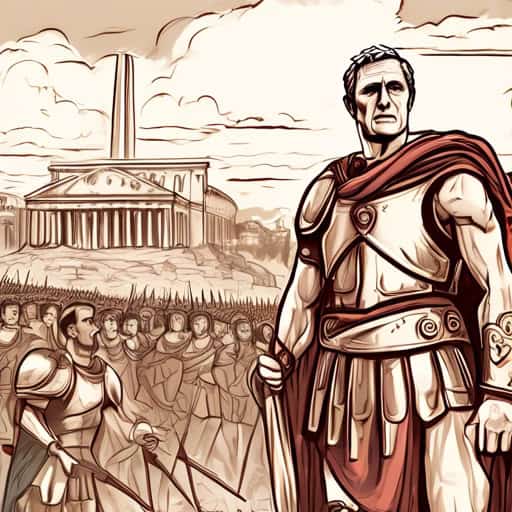
Julius Caesar
Pompey Magnus

Cicero
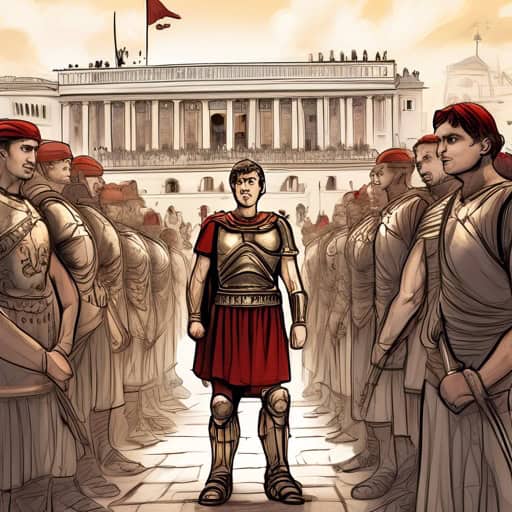
Mark Antony

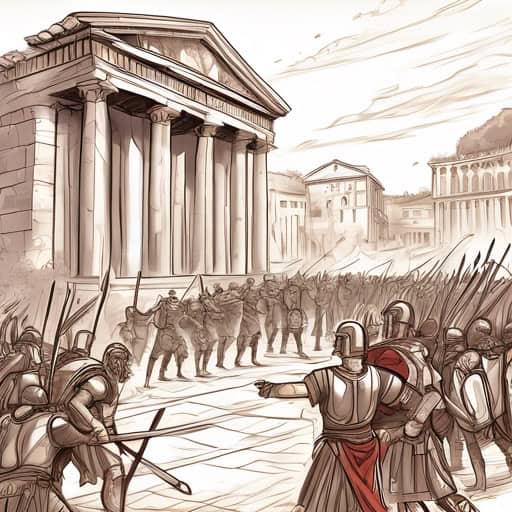
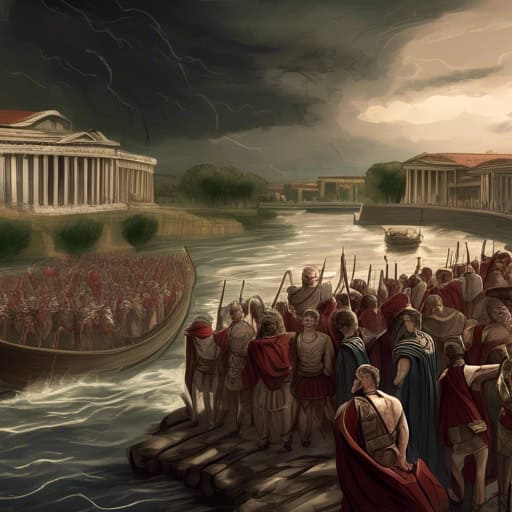
1. Julius Caesar Crosses the Rubicon

2. Caesars Advance on Rome

3. Battle of Pharsalus

4. Caesar in Egypt

5. Cleopatras Reign

6. Caesars Return to Rome

7. Assassination of Julius Caesar

8. Mark Antony and Octavian

9. Battle of Philippi

10. Establishment of the Roman Empire
Lesson Details & Resources
In a Nutshell
- What: A pivotal conflict that marked the beginning of the Roman Civil War.
- When: 49 BC
- Who: Julius Caesar and Pompey the Great
- Outcome: Pompey’s defeat and Caesar’s consolidation of power in Rome.
Famous Figures in the the Roman Civil War
-
Julius Caesar
A military general and statesman who played a critical role in the events leading to the civil war, eventually emerging as one of the key figures in Roman history.
-
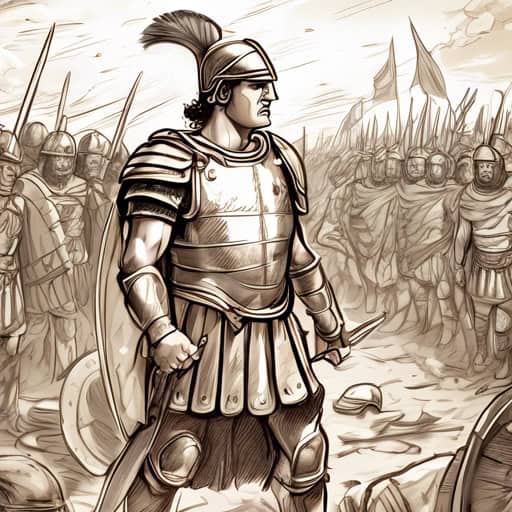
Pompey the Great
A renowned military and political leader who opposed Caesar in the civil war, seeking to maintain the power of the Senate and the traditional Roman Republic.
-
Cato the Younger
A senator known for his staunch opposition to Caesar and his unwavering defense of traditional Roman values and institutions.
-
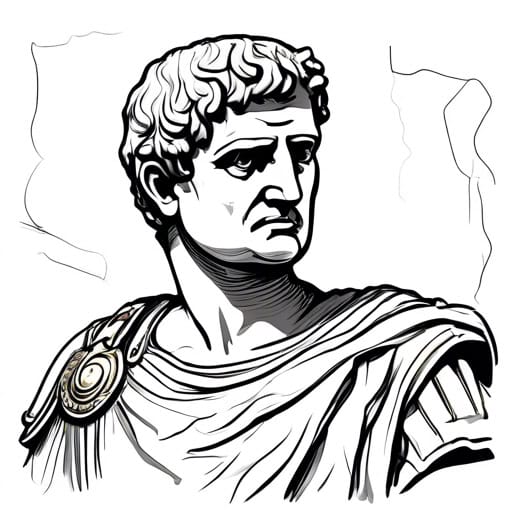
Mark Antony
A loyal ally of Caesar during the civil war, he later became one of his bitter rivals and was a prominent figure in the power struggle that followed Caesar's assassination.
-
Brutus
A senator and military leader who joined the conspiracy to assassinate Julius Caesar, believing it to be necessary for the preservation of the Roman Republic.
-
Cicero
One of Rome's greatest orators and philosophers, he was a prominent political figure who expressed his views on the civil war through his speeches and writings.
-
Octavian
The adopted son of Julius Caesar and his chosen heir, he played a pivotal role in the civil war and eventually became the first Emperor of the Roman Empire, taking the name Augustus.
-
Marcus Licinius Crassus
A wealthy Roman general and politician, he was a key supporter of Julius Caesar and played a role in the early stages of the civil war.
-
Publius Clodius Pulcher
A popular and influential politician who championed the rights of the plebeians, he engaged in political maneuvers and clashes with other figures during the civil war.
-
Lucius Cornelius Sulla
A military leader and politician who held significant power in Rome, he played a crucial role in the civil war and later became a dictator, implementing various reforms.
Timeline of the Roman Civil War
Caesar crosses the Rubicon River, starting the Roman Civil War
Caesar captures Rome and declares himself dictator
Caesar defeats Pompey at the Battle of Pharsalus
Pompey flees to Egypt and is assassinated upon arrival
Caesar appoints Cleopatra as the ruler of Egypt
Caesar defeats the remaining Pompeian forces in Africa
Caesar is declared dictator for life by the Roman Senate
Caesar implements various reforms in Rome
Caesar is assassinated on the Ides of March by a group of senators
Mark Antony delivers a famous funeral speech for Caesar
Octavian, Caesar's adopted son, forms the Second Triumvirate with Mark Antony and Lepidus
The Second Triumvirate defeats Caesar's assassins at the Battle of Philippi
Lepidus is sidelined and Antony becomes Cleopatra's lover
Octavian defeats Antony and Cleopatra at the Battle of Actium
Antony and Cleopatra commit suicide
Octavian becomes the sole ruler of Rome and takes the title Augustus
End of the Roman Republic and the beginning of the Roman Empire
Augustus implements numerous reforms and establishes a period of relative peace and stability known as the Pax Romana
Augustus dies and is succeeded by Tiberius
The Roman Empire continues to expand and prosper under successive emperors
Vocabulary List
- Caesar
- Roman general and statesman who played a critical role in the events that led to the demise of the Roman Republic
- Pompey
- Roman general and politician who was a rival of Caesar during the Roman Civil War
- Senate
- The highest deliberative and legislative body of the Roman Republic
- Dictator
- A political leader in ancient Rome who had absolute power and ruled for a limited time during times of crisis
- Triumvirate
- A political alliance between three individuals, such as the First Triumvirate formed by Caesar, Pompey, and Crassus
- Optimates
- A conservative political faction in the late Roman Republic that supported the aristocracy and opposed the populares
- Populares
- A political faction in the late Roman Republic that sought to champion the rights and interests of the common people
- Legion
- A large military unit of the Roman army, typically consisting of around 5,000 soldiers
- Cohort
- A subdivision of a Roman legion, consisting of around 500-600 soldiers
- Centurion
- A professional officer of the Roman army who commanded a century, a unit of around 80 soldiers
- Proconsul
- A governor of a province in ancient Rome, appointed by the Senate
- Gaul
- A region in Western Europe that encompasses present-day France, Belgium, and parts of neighboring countries
- Cisalpine Gaul
- The region of Gaul that lies on the southern side of the Alps, corresponding to modern-day northern Italy
- Rubicon
- A river in northeastern Italy that marked the boundary between Italy and Roman Gaul
- Crossing the Rubicon
- A phrase used to signify a point of no return or a moment of irreversible decision
- Legate
- A military officer who served as a deputy or representative of a higher-ranking commander
- Assassination
- The act of killing a prominent person, often for political or ideological reasons
- Optimate
- A member or supporter of the conservative political faction in the Roman Republic
- Populare
- A member or supporter of the political faction in the Roman Republic that championed the rights of the common people
- Civil war
- A conflict between different groups or factions within the same country or state.
Key Facts
This is the information used in the fact matching game
- Julius Caesar initiated the Roman Civil War in 49 BC
- The war was fought between Caesar's forces and those of the Roman Republic
- Caesar's opponents were led by Pompey the Great
- The war was sparked by political tensions and power struggles within the Roman Republic
- Caesar crossed the Rubicon River in northern Italy, which was considered an act of war
- Caesar's forces quickly advanced and took control of Rome
- Pompey and many senators fled to Greece
- Caesar pursued Pompey and defeated him in the Battle of Pharsalus
- Pompey was eventually assassinated in Egypt
- Caesar declared himself dictator and enacted various reforms
- Caesar's reforms included granting citizenship to more people and implementing land redistribution
- Caesar's rule caused further discontent among the Roman elite
- After Caesar's assassination in 44 BC, a power struggle ensued between his supporters and his opponents
- This power struggle ultimately resulted in the formation of the Second Triumvirate
- The Second Triumvirate consisted of Octavian (later known as Augustus), Mark Antony, and Lepidus
- The Triumvirate defeated Caesar's assassins in the Battle of Philippi
- Lepidus was eventually pushed aside, leaving Octavian and Antony as the key figures
- Octavian and Antony's alliance deteriorated, leading to another civil war
- The final battle of the Roman Civil War took place at Actium in 31 BC
- Octavian emerged victorious, and Antony and his lover Cleopatra committed suicide.
Analysis & Significance
Immediate Consequences
The Roman Civil War of 49 BC resulted in the defeat of Pompey the Great by Julius Caesar, solidifying Caesar’s power and control over Rome. This event led to a significant shift in the balance of power within the Roman Republic, with Caesar emerging as the sole ruler.
Long-Term Impact
The Roman Civil War of 49 BC marked the beginning of the end of the Roman Republic and the rise of the Roman Empire. Caesar’s victory paved the way for the establishment of a centralized imperial government, setting the stage for the reign of emperors and the transformation of Rome into a powerful empire.
Cultural Significance Today
The legacy of the Roman Civil War of 49 BC continues to influence modern political and military strategies. The transition from the Roman Republic to the Roman Empire serves as a cautionary tale about the dangers of unchecked power and the importance of maintaining democratic principles. Additionally, the conflict between Caesar and Pompey remains a symbol of the struggle for supremacy and control in times of political upheaval.
the Roman Civil War Games


Take Your Learning Offline
Want a convenient, print-ready study guide for this lesson? Become a Memory Wizards Pro member to unlock the downloadable " Memory Scrolls" for this topic and our entire library!
- ✓ Complete Vocabulary Lists
- ✓ Key Facts & Timelines
- ✓ Beautifully Formatted for Print & Mobile