
An Analysis of Anaximenes and the Air
What if air is the key to understanding the universe?
How Do You Learn Best?
Learn by Listening
Start with the 3-minute audio summary to get the key facts and narrative highlights quickly.
Learn by Reading
Immerse yourself in the 10-minute visual lesson for a comprehensive understanding of the topic.
Learn by Reviewing
Jump directly to the key facts, timeline, and vocabulary lists to build a solid foundation of details.
Learn by Doing
Challenge yourself! Jump straight into the interactive games to learn by trial, error, and discovery.
Audio Library
As one of our featured lessons, this topic includes premium audio guides.
Unlock the Wizard's Cram Session
This powerful audio study guide is a Pro-exclusive feature. Upgrade to Memory Wizards Pro to access this and all of our premium learning tools.
Upgrade to ProAn Anaximenes and the Air in 10 Minutes
Introduction

Thales
Anaximander
Anaximenes
Pythagoras

The Birth of Anaximenes

Air as the Fundamental Element

The Role of Air in Nature
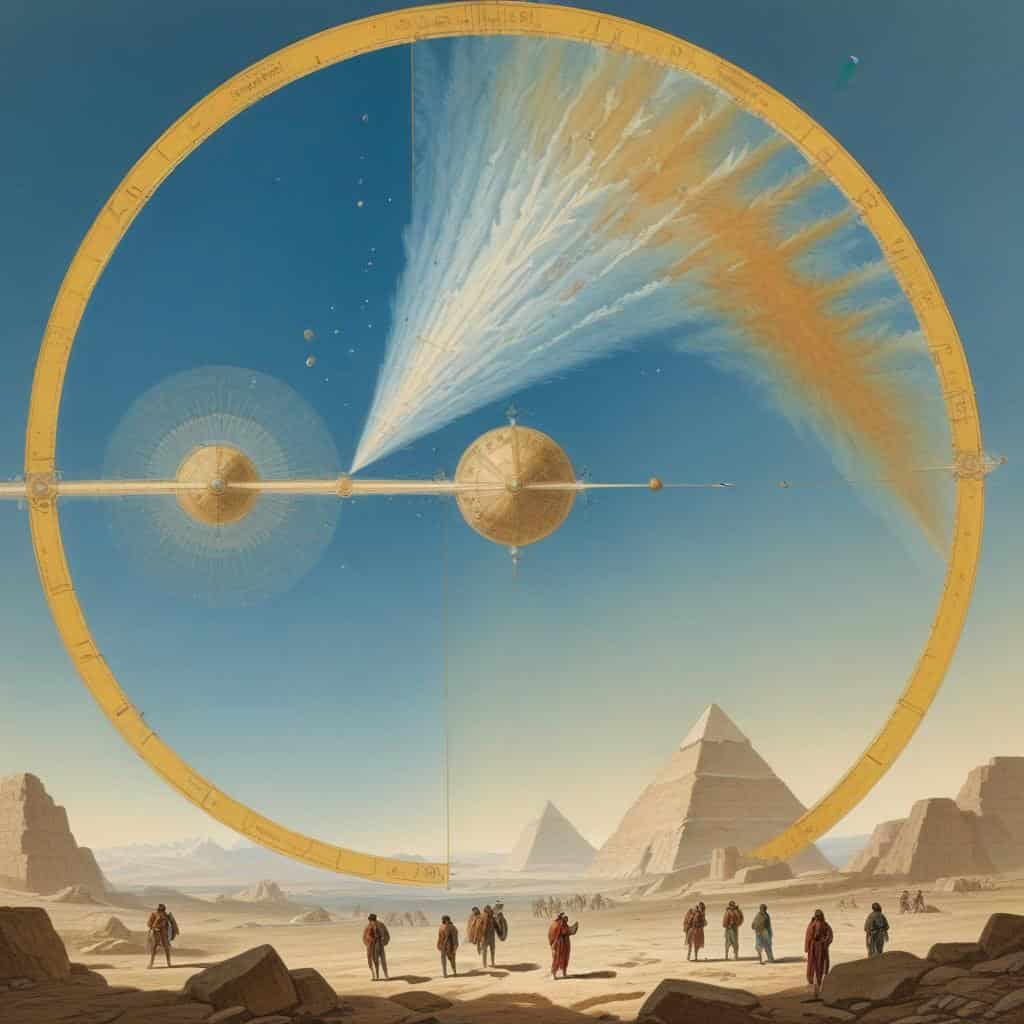
Implications for Cosmology
Legacy of Anaximenes
Lesson Details & Resources
In a Nutshell
- Concept: A philosophical concept that identifies air as the fundamental substance of the universe.
- Thinkers: Anaximenes, 6th century BC.
- Central Question: What is the basic element that underlies all existence?
- Core Implication: The belief that air is the primary substance that transforms into different forms to create all things in the world.
Timeline of An Anaximenes and the Air
Anaximenes develops the concept of Air as the primary substance in the universe
Anaximenes believes that all matter is composed of Air, which can be transformed into other elements through rarefaction and condensation
Anaximenes argues that Air is eternal and infinite, encompassing everything in the cosmos
Anaximenes' philosophy is influenced by his predecessors Thales and Anaximander
Anaximenes' teachings are passed down through his students, including Anaximander and Pythagoras
Anaximenes' cosmology posits that the Earth is a flat disk floating on Air, with the sky being a dome-shaped canopy held up by Air
Anaximenes' concept of Air as the fundamental substance foreshadows later theories of the elements in Greek philosophy
Anaximenes' ideas on Air influence later philosophers such as Heraclitus and Empedocles
Anaximenes' emphasis on Air as a dynamic and transformative force contributes to the development of process philosophy
Anaximenes' work is preserved in fragments and references in later philosophical texts
Anaximenes' philosophy remains a significant contribution to the history of metaphysics and cosmology
Vocabulary List
- Air
- Anaximenes believed that air was the fundamental substance that all things were made of.
- Aer
- Anaximenes considered aer (mist or vapor) to be a condensed form of air.
- Pneuma
- Anaximenes used the term pneuma to refer to the divine breath or vital force that animates all living beings.
- Boundless
- Anaximenes described air as boundless and infinite, capable of transforming into different states.
- Cosmos
- Anaximenes believed that the cosmos was formed through the condensation and rarefaction of air.
- Infinity
- Anaximenes thought that air was infinite and eternal, existing before and after all things.
- Condensation
- Anaximenes proposed that when air condenses, it transforms into denser forms of matter.
- Redefinition
- Anaximenes redefined Thales' concept of water as the fundamental substance to air, emphasizing its dynamic and transformative nature.
Key Facts
This is the information used in the fact matching game
- Anaximenes was a pre-Socratic philosopher who believed that air was the fundamental substance of the universe.
- Anaximenes believed that air could condense and rarefy, creating different substances and phenomena in the world.
- Anaximenes thought that air was infinite and eternal, encompassing all things in the universe.
- Air, for Anaximenes, was the source of all other elements such as fire, water, and earth.
- Anaximenes believed that air was in constant motion, leading to the creation and destruction of all things.
- Anaximenes' philosophy influenced later Greek thinkers such as Heraclitus and Empedocles.
- The concept of air as the primary substance in the universe challenged earlier theories of water and earth.
- Anaximenes' belief in air as the fundamental substance laid the groundwork for later atomistic theories in ancient philosophy.
- Some scholars interpret Anaximenes' theory of air as a metaphor for the divine or cosmic soul that animates the universe.
- Anaximenes' emphasis on air as the source of life and motion foreshadowed modern scientific understanding of gases and their behavior.
- Anaximenes' idea of air as the primary substance challenged traditional religious beliefs in gods and mythical beings as the creators of the world.
- Anaximenes' philosophy contributed to the development of rationalistic and naturalistic explanations for the natural world in ancient Greece.
- Anaximenes' focus on air as the primary substance led to the rejection of supernatural explanations for natural phenomena in philosophy.
- Anaximenes' theory of air as the fundamental substance resonated with later thinkers in the Islamic and medieval European traditions.
- Anaximenes' concept of air as the source of all things laid the foundation for modern scientific theories of matter and energy.
- Anaximenes' philosophy of air as the primary substance influenced early Greek theories of cosmology and astronomy.
- Anaximenes' idea that air could transform into other elements inspired later alchemical and mystical traditions in the Middle Ages.
- Anaximenes' belief in air as the animating force of the universe challenged traditional views of creation and existence in ancient Greek society.
- Anaximenes' philosophy of air as the primary substance contributed to the development of materialistic and atheistic views in ancient philosophy.
- Anaximenes' theory of air as the origin of all things highlighted the interconnectedness and unity of the natural world in his philosophy.
Analysis & Significance
The Core Argument
Anaximenes, a pre-Socratic philosopher, proposed that the fundamental substance of the universe is not water or fire, as Thales and Heraclitus believed, but rather air. He argued that air, when condensed or rarefied, can transform into different elements, thus explaining the variety of matter in the world.
Criticisms and Counterarguments
Critics of Anaximenes’ theory argue that his reliance on a single substance, air, oversimplifies the complexity of the natural world. They question how air alone can account for the diversity of elements and phenomena observed in reality. Additionally, some philosophers point out the lack of empirical evidence to support Anaximenes’ claims about the transformative nature of air.
Modern Relevance
Despite its ancient origins, Anaximenes’ concept of air as the primary substance offers a valuable perspective on the interconnectedness of all things. In a modern context, this idea can be applied metaphorically to emphasize the importance of recognizing the unity and interdependence of individuals and societies. By understanding that we all share a common essence, we can foster empathy, cooperation, and harmony in a world filled with diversity and division.
An Anaximenes and the Air Games


Take Your Learning Offline
Want a convenient, print-ready study guide for this lesson? Become a Memory Wizards Pro member to unlock the downloadable " Memory Scrolls" for this topic and our entire library!
- ✓ Complete Vocabulary Lists
- ✓ Key Facts & Timelines
- ✓ Beautifully Formatted for Print & Mobile