
Explore the Lessons
Dualism Vs. Physicalism
Are we just minds in bodies or more than mere matter?
The Problem Of Consciousness
Can we ever truly understand the nature of our consciousness?
Intentionality And Mental Content
Are we intentional creators or passive recipients of mental content?
The Nature Of Mental States
Can we ever truly escape the web of our thoughts?
Theories Of Personal Identity
Are we the same person we were yesterday?
The Mind-body Problem
Where does the mind end and the body begin?
Free Will And Determinism
Can we truly shape our own destinies?
Mental Causation
What shapes our thoughts and reality?
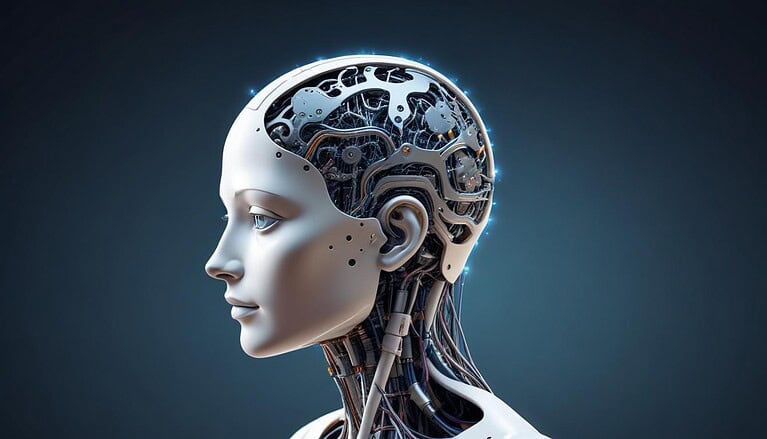
Artificial Intelligence And The Mind
Can machines truly understand the complexities of human consciousness?
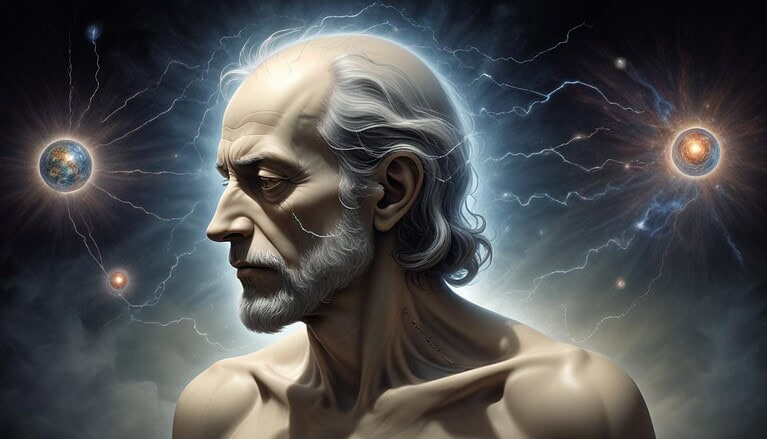
The Hard Problem Of Consciousness
Can we truly understand the essence of our own consciousness?
Timeline
Mind-body dualism (Plato)
Perception and knowledge (Aristotle)
Cogito, ergo sum (Descartes)
Theory of ideas (Locke)
Critique of pure reason (Kant)
Phenomenology (Husserl)
Stream of consciousness (James)
Behaviorism (Watson)
Logical positivism (Carnap)
Identity theory (Place)
Functionalism (Putnam)
Multiple realizability (Fodor)
Chinese Room Argument (Searle)
Qualia (Jackson)
Functionalism and machine intelligence (Dennett)
Extended mind thesis (Clark & Chalmers)
Neurophilosophy (Churchland)
Embodied cognition (Varela)