
How Do You Learn Best?
Learn by Reading
Immerse yourself in the 10-minute visual lesson for a comprehensive understanding of the topic.
Learn by Reviewing
Jump directly to the key facts, timeline, and vocabulary lists to build a solid foundation of details.
Learn by Doing
Challenge yourself! Jump straight into the interactive games to learn by trial, error, and discovery.
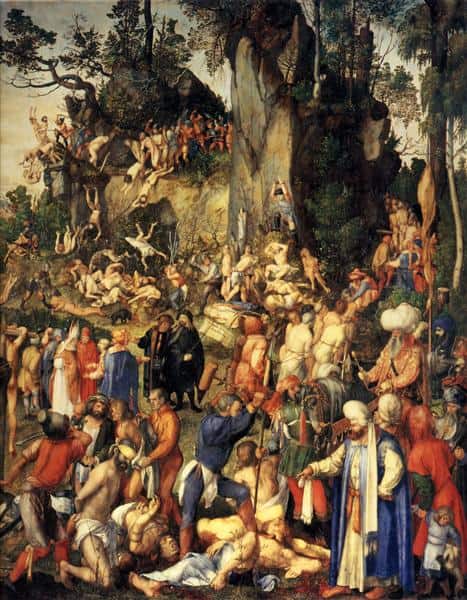
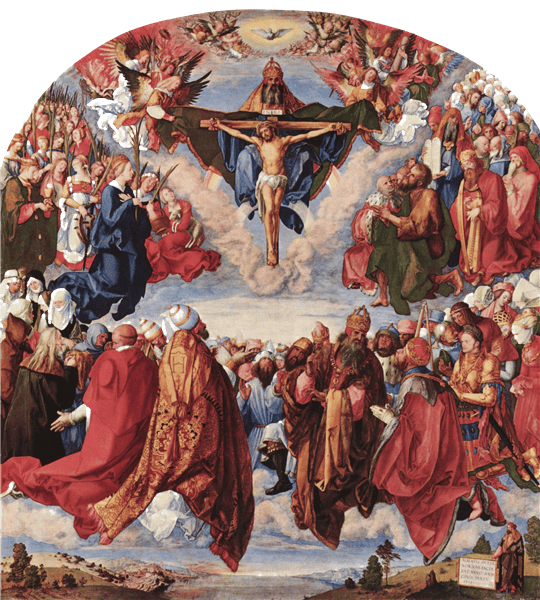
The Masterpiece: Martyrdom Of The Ten Thousand Albrecht Durer
Deconstructing the Masterpiece
Diagonal Composition
The figures are arranged diagonally, leading the viewer's eye through the chaotic scene and creating a sense of movement and drama.
Foreshortening
The use of foreshortening in the figures adds depth and realism to the composition, enhancing the sense of space and perspective.
Symbolism of Suffering
The depiction of the martyrs in various stages of agony and distress serves as a powerful symbol of sacrifice and martyrdom.
Crowded Composition
The crowded composition of the figures creates a sense of chaos and overwhelming numbers, emphasizing the magnitude of the event.
Albrecht Dürer: An Analysis in 10 Minutes
Early Life and Education
Travels to Italy
Artistic Achievements
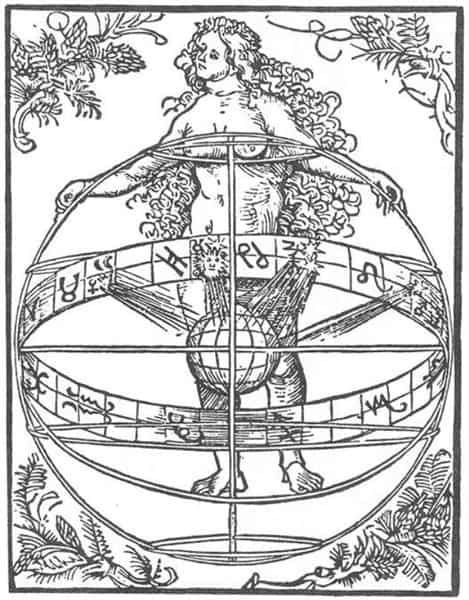
Innovations in Printmaking
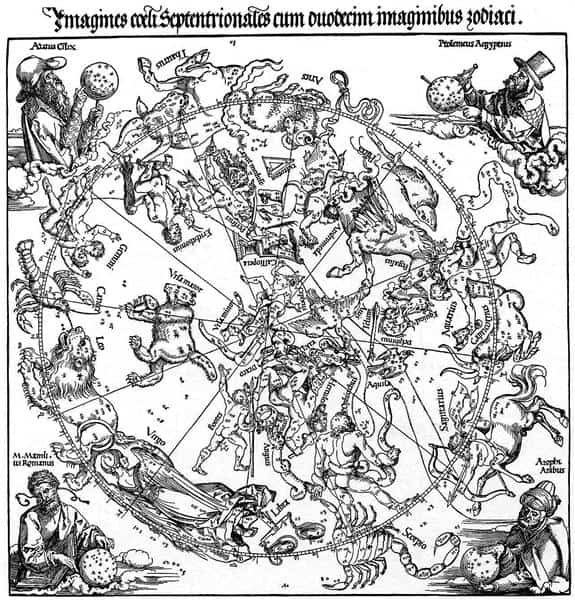
Impact on the Northern Renaissance
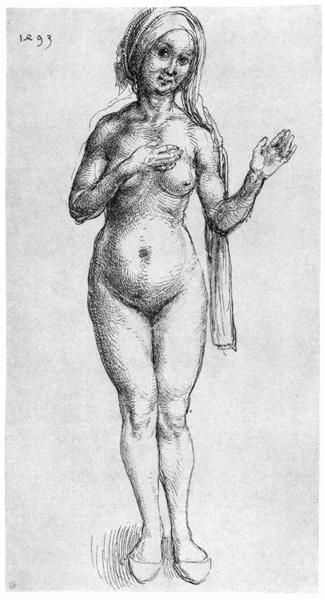
Relationship with Humanism
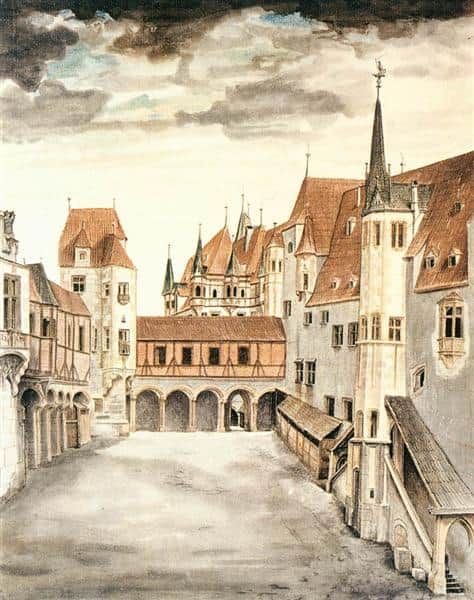
Reputation and Legacy
Death and Influence
Lesson Details & Resources
In a Nutshell
- Artist: Albrecht Dürer
- Year: 1514
- Medium: Engraving
- Location: Metropolitan Museum of Art, New York City
Vocabulary List
- Engraving
- Dürer was known for his skill in engraving, a technique he used to create intricate and detailed prints.
- Woodcut
- Dürer also excelled in woodcut prints, showcasing his mastery of this medium.
- Proportion
- Dürer's artwork often emphasized the importance of proportion, particularly in his human figures.
- Perspective
- Dürer was one of the first artists to explore the use of perspective in his works, creating a sense of depth and realism.
- Allegory
- Dürer frequently used allegorical symbols in his artwork to convey deeper meanings and messages.
- Symbolism
- Symbolism played a significant role in Dürer's artwork, with each element carefully chosen to represent specific ideas or concepts.
- Iconography
- Dürer's artwork often featured complex iconography, with each symbol carrying layers of meaning.
- Etching
- While primarily known for his engravings and woodcuts, Dürer also experimented with etching as a printmaking technique.
- Self-portrait
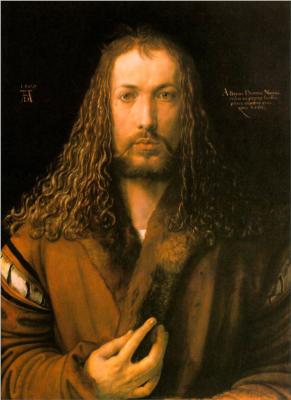
- Dürer created several self-portraits throughout his career, providing insight into his appearance and personality.
- Humanism
- Dürer's work reflected the humanist ideals of the Renaissance, emphasizing the importance of human potential and achievement.
- Classical
- Dürer drew inspiration from classical art and literature, incorporating elements of this tradition into his own work.
- Anatomy
- Dürer's meticulous attention to anatomy is evident in his detailed drawings of the human figure.
- Printmaking
- Dürer was a pioneer in the field of printmaking, popularizing the medium and elevating it to an art form.
- Etching
- Dürer's etchings are characterized by their delicate lines and intricate details, showcasing his technical skill.
- Religious
- Dürer's artwork often had religious themes, reflecting the spiritual beliefs of his time.
- Mythology
- Dürer incorporated elements of mythology into his work, drawing on classical stories and legends for inspiration.
- Landscape
- Dürer's landscapes were highly detailed and realistic, capturing the beauty of the natural world.
- Portrait
- Dürer was skilled at capturing the likeness and personality of his subjects in his portraits.
- Genre scene
- Dürer occasionally painted genre scenes, depicting everyday life in a realistic and relatable manner.
- Draftsmanship
- Dürer's exceptional draftsmanship is evident in his precise and detailed drawings.
- Albrecht dürer
- Albrecht Dürer was a renowned German artist of the Northern Renaissance, known for his prints, paintings, and drawings.
Timeline of Albrecht Dürer: An Analysis
Albrecht Dürer is born in Nuremberg, Holy Roman Empire
Dürer begins his apprenticeship with Michael Wolgemut
Dürer completes his apprenticeship and becomes a journeyman painter
Dürer travels to Colmar, France and Basel, Switzerland to further his artistic studies
Dürer creates his first major work, the woodcut series 'Apocalypse'
Dürer marries Agnes Frey
Dürer completes his famous self-portrait at the age of 28
Dürer travels to Venice, Italy and is influenced by Italian Renaissance art
Dürer becomes a court artist for the Holy Roman Emperor Maximilian I
Dürer publishes his theoretical work 'Four Books on Human Proportion'
Dürer dies in Nuremberg at the age of 56
Dürer's works continue to influence artists throughout Europe for centuries to come
Dürer's engravings and woodcuts are highly regarded for their technical skill and detail
Dürer's masterpiece 'Melencolia I' is completed
Dürer travels to the Netherlands and meets with other Renaissance artists such as Lucas van Leyden
Dürer's work 'The Four Horsemen of the Apocalypse' is completed
Dürer's watercolor paintings demonstrate his mastery of the medium
Dürer's 'Adam and Eve' engraving is completed
Dürer's woodcut series 'The Life of the Virgin' is completed
Dürer's influence extends beyond his own lifetime, impacting later artists such as Rembrandt and Titian
Key Facts
This is the information used in the fact matching game
- Albrecht Dürer was a German painter, printmaker, and theorist of the Northern Renaissance.
- Dürer is considered one of the greatest artists of the Renaissance period.
- He was known for his detailed and realistic portraits, as well as his woodcuts and engravings.
- Dürer traveled extensively throughout Europe, studying and working with other artists.
- He was particularly influenced by Italian Renaissance artists such as Leonardo da Vinci and Raphael.
- Dürer's most famous works include 'Knight, Death, and the Devil' and 'Melencolia I'.
- He was also skilled in creating self-portraits, producing over 30 in his lifetime.
- Dürer's engravings are highly regarded for their technical skill and attention to detail.
- He played a key role in popularizing printmaking in Europe during the Renaissance period.
- Dürer's work often featured religious themes, reflecting the influence of his Christian upbringing.
- He was also interested in scientific principles, incorporating elements of mathematics and geometry into his art.
- Dürer's detailed studies of animals and plants were groundbreaking for their accuracy and attention to naturalistic detail.
- He was a prolific writer, publishing treatises on art theory and technique.
- Dürer's influence extended beyond his own artwork, inspiring generations of artists in Europe and beyond.
- He was a master of perspective, using techniques such as foreshortening to create depth and realism in his compositions.
- Dürer's work was highly sought after during his lifetime, leading to commissions from wealthy patrons and rulers.
- He was a pioneer in the field of self-promotion, using his prints and engravings to establish his reputation as an artist.
- Dürer's legacy continues to be celebrated today, with exhibitions and scholarly studies dedicated to his life and work.
- His works are held in major museums and collections around the world, testifying to his enduring influence on the art world.
- Dürer's impact on the art world can be seen in the way he combined technical skill with artistic vision, creating timeless masterpieces that continue to inspire artists and art lovers alike.
Analysis & Significance
Artistic Innovation
Albrecht Dürer’s detailed engravings and woodcuts revolutionized the art of printmaking in the Northern Renaissance. His use of light and shadow, intricate patterns, and precise anatomical accuracy brought a new level of realism and depth to his works, setting a standard for printmaking techniques that would influence generations of artists.
Influence on Art History
Dürer’s innovative approach to printmaking not only elevated the status of graphic arts but also inspired future generations of artists, including Rembrandt and Goya. His emphasis on individual creativity and technical skill helped shift the perception of printmaking from a purely reproductive medium to a form of artistic expression in its own right.
Cultural Significance Today
Albrecht Dürer’s prints continue to be celebrated as masterpieces of art history, with his iconic works such as “Knight, Death, and the Devil” and “Melencolia I” still captivating audiences around the world. His influence on printmaking techniques and his legacy as a pioneering artist make him a revered figure in the canon of Western art.
Albrecht Dürer: An Analysis Games


Take Your Learning Offline
Want a convenient, print-ready study guide for this lesson? Become a Memory Wizards Pro member to unlock the downloadable " Memory Scrolls" for this topic and our entire library!
- ✓ Complete Vocabulary Lists
- ✓ Key Facts & Timelines
- ✓ Beautifully Formatted for Print & Mobile