
At a Glance - Infographic
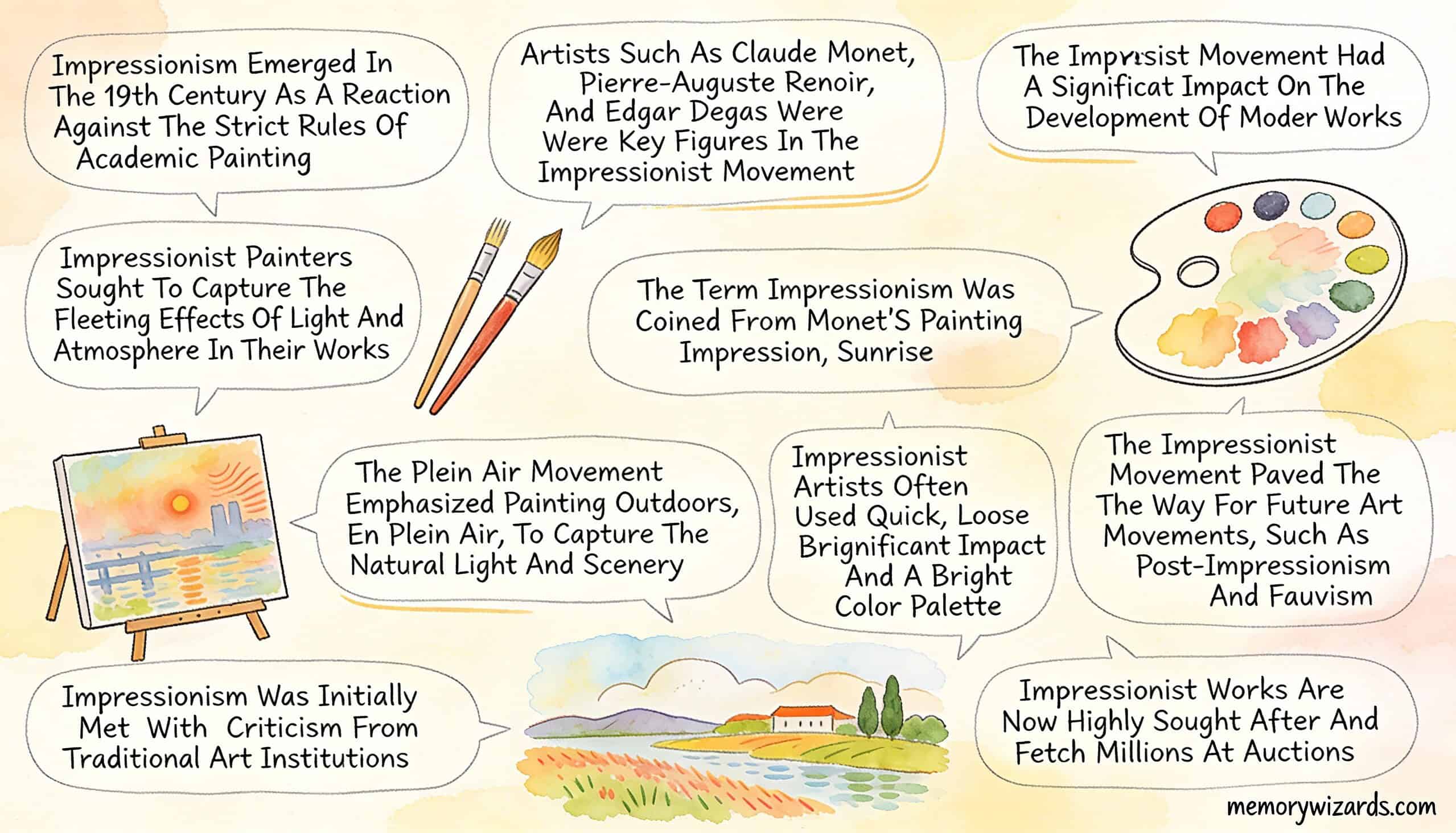
How Do You Learn Best?
Learn by Listening
Start with the 3-minute audio summary to get the key facts and narrative highlights quickly.
Learn by Reading
Immerse yourself in the 10-minute visual lesson for a comprehensive understanding of the topic.
Learn by Reviewing
Jump directly to the key facts, timeline, and vocabulary lists to build a solid foundation of details.
Learn by Doing
Challenge yourself! Jump straight into the interactive games to learn by trial, error, and discovery.
Example of Plein Air Movement: Monet's Garden in Giverny

Deconstructing Plein Air Movement
Impressionistic Brushwork
Loose and broken brushstrokes create a sense of movement and spontaneity, capturing fleeting moments and emotions.
Plein Air Technique
Painting outdoors allows artists to capture natural light and atmosphere, resulting in vibrant colors and a sense of immediacy.
Focus on Light and Color
Emphasis on the effects of light and color over realistic representation, conveying the artist's subjective experience and perception.
Lack of Detail
Simplified forms and lack of precise details evoke a sense of spontaneity and suggest the transient nature of the scene.
Audio Library
As one of our featured lessons, this topic includes premium audio guides.
Unlock the Wizard's Cram Session
This powerful audio study guide is a Pro-exclusive feature. Upgrade to Memory Wizards Pro to access this and all of our premium learning tools.
Upgrade to ProA Guide to Impressionism and the Plein Air Movement in 10 Minutes
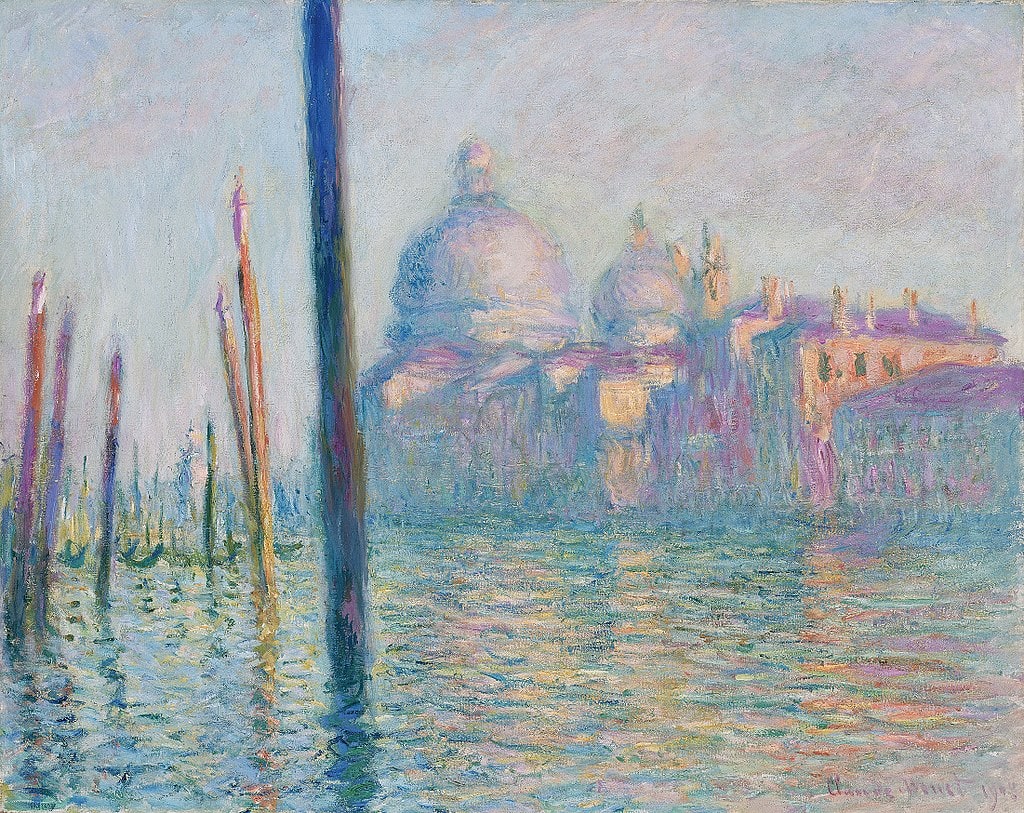
The Birth of Impressionism

Characteristics of Impressionist Art
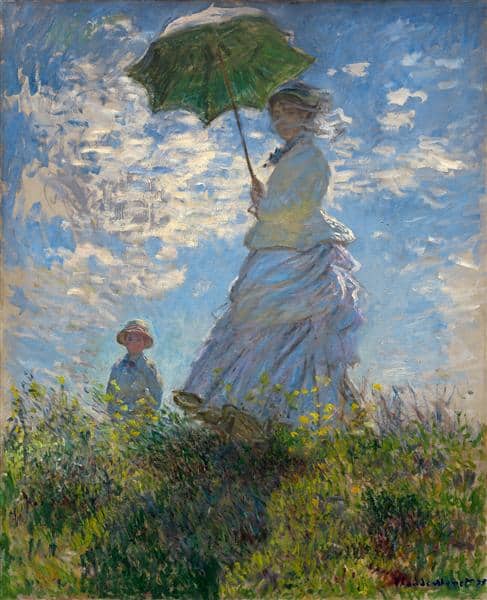
The Plein Air Movement
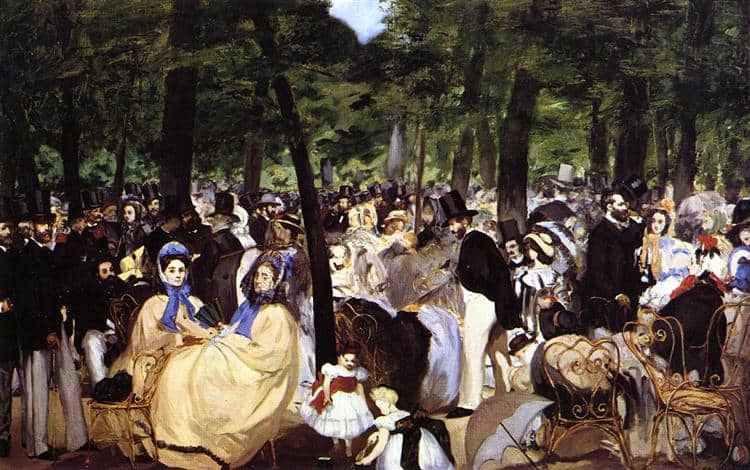
Impact of Impressionism
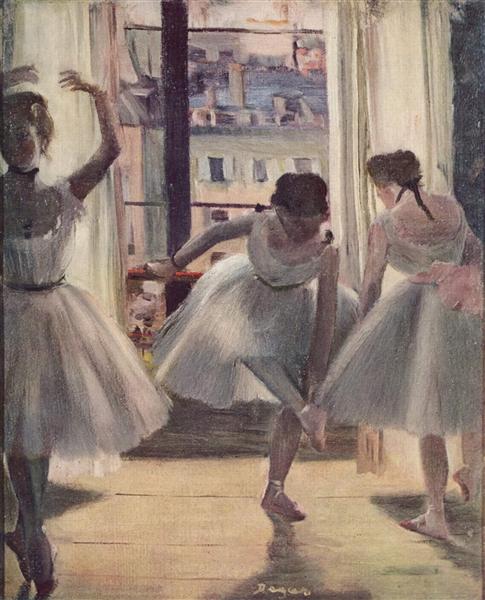
Key Artists of the Impressionist Movement

Exhibitions and Criticism
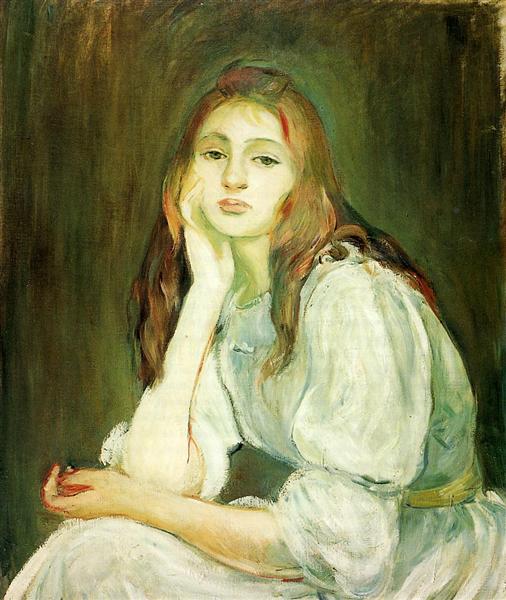
Legacy of Impressionism
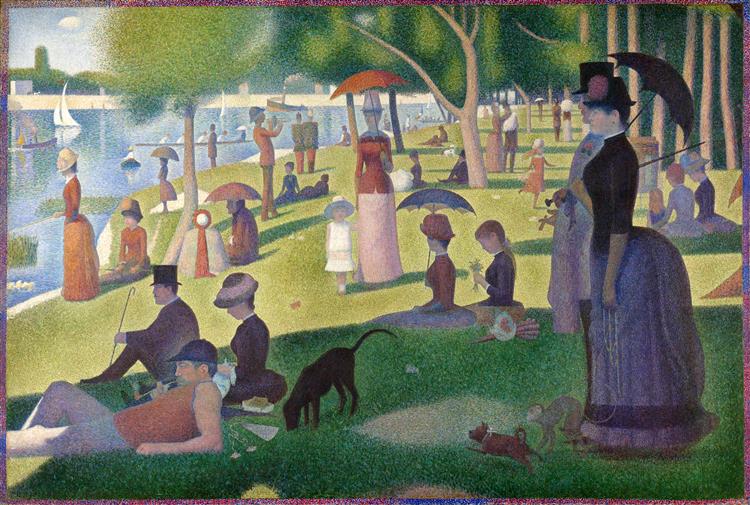
Continued Influence on Art
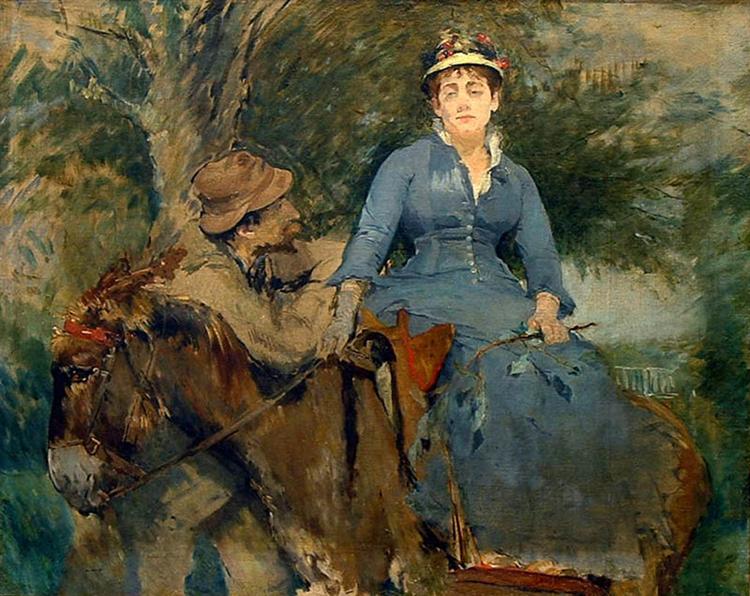
Popularization of Plein Air Painting
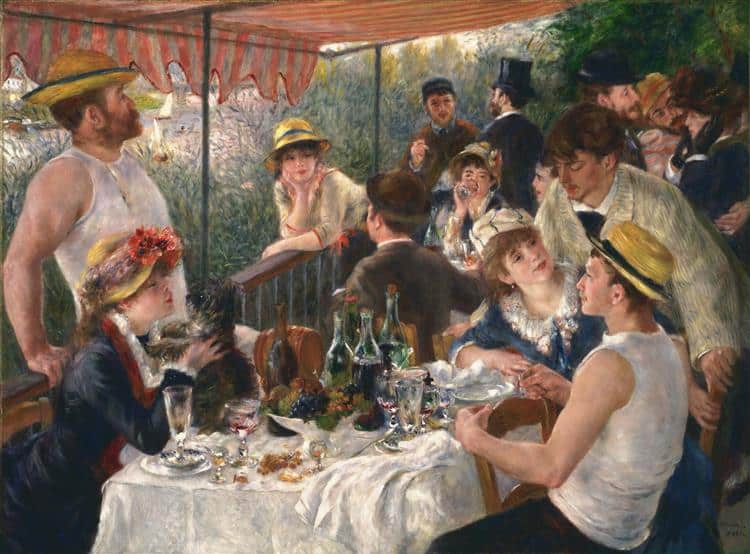
Exploration of Light and Color
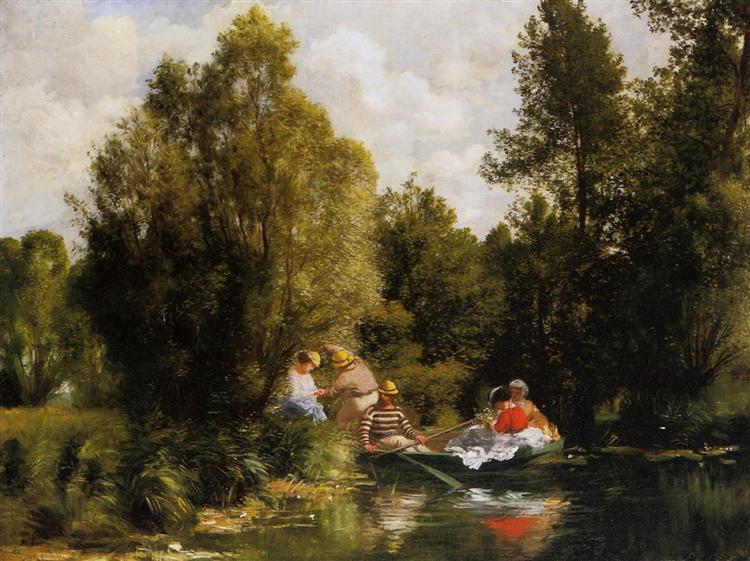
Lesson Details & Resources
In a Nutshell
- When: Late 19th century
- Characteristics: Light, color, brush strokes
- Key Artists: Claude Monet, Pierre-Auguste Renoir, Camille Pissarro
- Major Work: The Artist’s Garden at Giverny” by Claude Monet
Vocabulary List
- Impressionism
- The art movement that originated in the late 19th century, characterized by visible brushstrokes, emphasis on light and color, and capturing the immediate impression of a scene.
- Plein Air
- Refers to the act of painting outdoors, directly from nature, as opposed to working in a studio.
- Landscape
- A genre of art that depicts natural scenery, such as mountains, valleys, trees, rivers, and skies.
- Light
- An essential element in impressionist paintings, artists often focused on capturing the effects of natural and atmospheric light.
- Color
- Impressionists used vibrant and contrasting colors to depict their subjects, often using broken brushstrokes to create optical mixing.
- Brushstrokes
- The visible marks made by a brush on a canvas, impressionists used loose and expressive brushstrokes to capture the essence of a scene.
- Atmosphere
- Impressionists aimed to convey the overall feel or mood of a scene, often depicting hazy or diffused atmospheric conditions.
- Naturalism
- A style of painting that aims to depict the natural world realistically, often with attention to detail and accuracy.
- En plein air
- A French phrase that translates to 'in the open air,' often used to describe outdoor painting.
- Scenes
- Impressionists frequently painted everyday scenes from modern life, including cityscapes, parks, cafes, and leisure activities.
- Technique
- Refers to the methods and skills used by artists, impressionist techniques include quick brushwork, thick paint application, and capturing the transient effects of light.
- Subjectivity
- Impressionists aimed to capture their personal impression or subjective response to a scene, rather than focusing on objective representation.
- Composition
- The arrangement and organization of elements within a work of art, impressionists often used unconventional compositions and cropped perspectives.
- Nature
- Impressionists took inspiration from the natural world, frequently painting landscapes, seascapes, and gardens.
- Movement
- The impressionist movement challenged traditional art conventions and techniques, emphasizing spontaneity, freedom, and capturing the fleeting nature of light and color.
- Reflection
- Impressionists often depicted the reflection of light on water or other surfaces, capturing its shimmering and ever-changing qualities.
- Capture
- Impressionists aimed to capture the essence and fleeting nature of a scene, often painting swiftly and spontaneously to preserve the immediate impression.
- Visible
- Impressionist artworks often show visible brushstrokes, the texture of the paint, and the artist's process, giving a sense of movement and immediacy.
- Outdoor
- Impressionists were known for painting outdoors, embracing the challenges and pleasures of working directly from nature.
- Modern
- The impressionist movement emerged during a time of significant societal and artistic change, reflecting the spirit of modernity and capturing contemporary life.
Timeline of A Guide to Impressionism and the Plein Air Movement
First Impressionist exhibition held in Paris
Monet's painting Impression, Sunrise exhibited
Cezanne, Pissarro, Monet, and Renoir form the Impressionist group
Manet's painting Luncheon on the Grass exhibited
Berthe Morisot becomes the first woman to exhibit with the Impressionists
Degas' painting The Dance Class exhibited
Renoir's painting Le Moulin de la Galette exhibited
Gustave Caillebotte joins the Impressionist group
Pissarro's painting Boulevard Montmartre, Afternoon Sun exhibited
Mary Cassatt exhibits with the Impressionists
First Impressionist exhibition held in London
Edouard Manet dies
Monet's series of Haystacks paintings exhibited
Renoir's painting Luncheon of the Boating Party exhibited
Degas' painting The Tub exhibited
Pissarro's painting The Boulevard Montmartre at Night exhibited
Monet's series of Water Lilies paintings exhibited
Last Impressionist exhibition held in Paris
Berthe Morisot dies
Cezanne's painting The Card Players exhibited
Key Facts
This is the information used in the fact matching game
- Impressionism was an art movement that emerged in the late 19th century.
- The term 'Impressionism' was derived from the title of Claude Monet's painting 'Impression, Sunrise.'
- Impressionist artists sought to capture the fleeting and ever-changing effects of light and atmosphere.
- Plein air painting refers to the practice of painting outdoors, directly from nature.
- The Plein Air Movement encouraged artists to work quickly and capture the immediate impression of a scene.
- Impressionists often used loose brushwork and vibrant colors to convey the effects of light and movement.
- Édouard Manet, although not strictly an Impressionist, was a significant influence on the movement.
- Prominent Impressionist artists include Claude Monet, Pierre-Auguste Renoir, and Edgar Degas.
- Impressionism challenged the traditional art establishment and was initially met with criticism.
- The first Impressionist exhibition took place in Paris in 1874.
- Impressionists often depicted modern life, including scenes of leisure, urban landscapes, and industrialization.
- Mary Cassatt was the only American artist associated with the Impressionist movement.
- Japanese woodblock prints, known as ukiyo-e, influenced Impressionist compositions and cropping.
- Impressionism had a significant impact on the development of modern art and paved the way for later movements.
- Impressionists often painted en plein air to capture the changing qualities of natural light.
- The use of broken brushstrokes and the play of complementary colors became characteristic of Impressionist artwork.
- Impressionists focused on capturing the overall impression of a scene rather than the details.
- Impressionism was seen as a revolutionary departure from the academic art of the time.
- The development of portable paint tubes allowed Impressionist artists to paint outdoors more easily.
- Impressionism was initially met with criticism, but gradually gained acceptance and popularity.
Analysis & Significance
Historical Context
The Impressionism movement emerged in the mid-19th century as a response to the strict rules and conventions of the academic art establishment. Artists sought to capture fleeting moments of everyday life with a focus on light, color, and atmosphere. The Plein Air Movement, which translated to “open air” in French, was a key aspect of Impressionism, as artists painted outdoors to capture the changing effects of light and atmosphere directly from nature.
Defining Characteristics
Impressionist paintings are characterized by loose brushwork, visible brushstrokes, and a focus on capturing the effects of light and color. Artists often depicted scenes of modern urban life, landscapes, and leisure activities. The use of vibrant colors and a sense of movement in the paintings set Impressionism apart from the more traditional styles of the time.
Lasting Influence
The Impressionist movement had a significant impact on subsequent art movements, such as Post-Impressionism, Fauvism, and Cubism. Artists like Claude Monet, Edgar Degas, and Pierre-Auguste Renoir paved the way for modern art by challenging traditional techniques and subject matter. The emphasis on capturing the fleeting moment and the use of light and color continue to influence artists today, making Impressionism a lasting and influential movement in the history of art.
A Guide to Impressionism and the Plein Air Movement Games


Take Your Learning Offline
Want a convenient, print-ready study guide for this lesson? Become a Memory Wizards Pro member to unlock the downloadable " Memory Scrolls" for this topic and our entire library!
- ✓ Complete Vocabulary Lists
- ✓ Key Facts & Timelines
- ✓ Beautifully Formatted for Print & Mobile