
Eclecticism: Synthesizing Ideas
Can we find unity in the diversity of our thoughts?
How Do You Learn Best?
Learn by Reading
Immerse yourself in the 10-minute visual lesson for a comprehensive understanding of the topic.
Learn by Reviewing
Jump directly to the key facts, timeline, and vocabulary lists to build a solid foundation of details.
Learn by Doing
Challenge yourself! Jump straight into the interactive games to learn by trial, error, and discovery.
Eclecticism: Synthesizing Ideas in 10 Minutes

Introduction



Plato

Immanuel Kant

Arthur Schopenhauer

John Stuart Mill
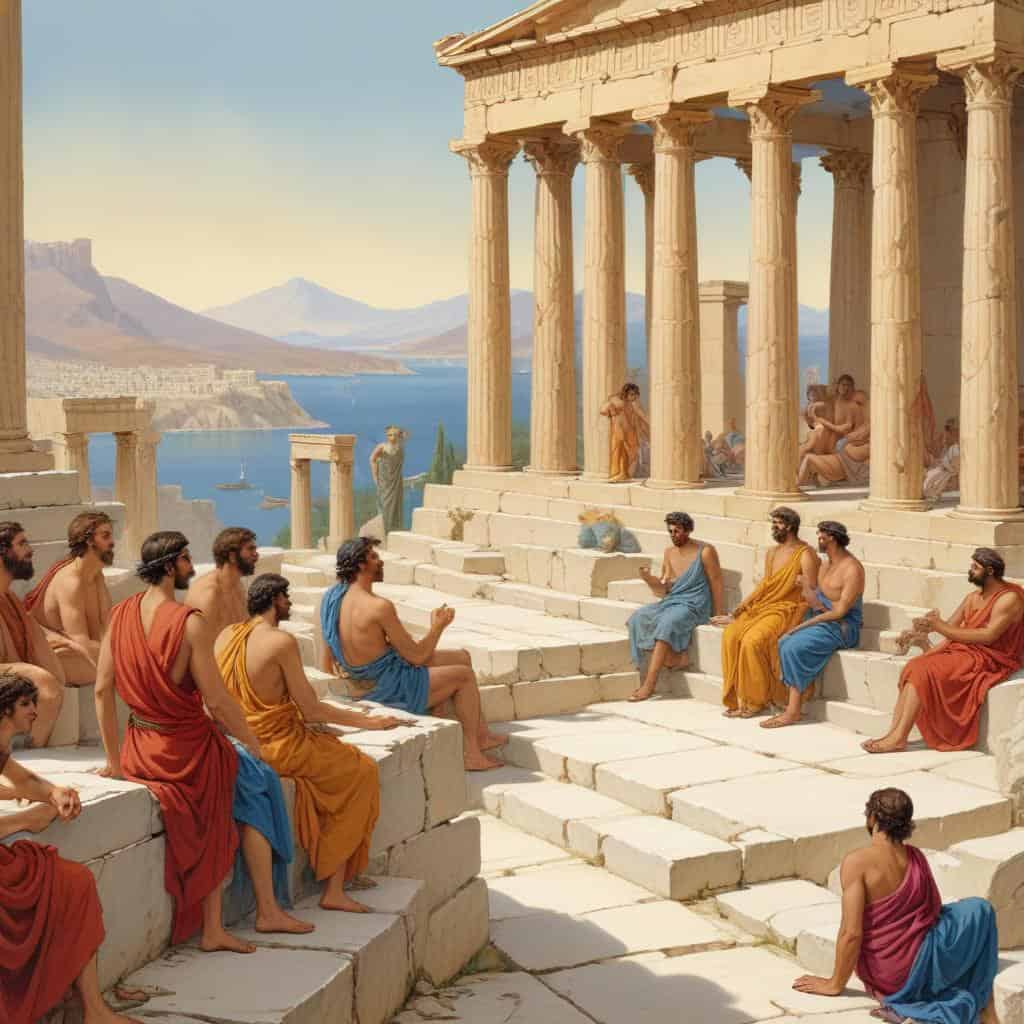
1. The Origin of Eclecticism

2. Definition of Eclecticism
3. The Role of the Eclectic Philosopher

4. Eclecticism in Modern Philosophy

5. Benefits of Eclecticism

6. Challenges of Eclecticism

7. Eclecticism in Practice

8. Examples of Eclecticism

9. Eclecticism in Everyday Life


Lesson Details & Resources
In a Nutshell
- Concept: A philosophical approach that combines ideas from various sources to create a cohesive whole.
- Thinkers: No specific philosopher, but prominent in ancient and modern philosophy.
- Central Question: How can different perspectives be integrated to form a comprehensive understanding?
- Core Implication: By synthesizing diverse ideas, a richer and more comprehensive worldview can be achieved.
Timeline of Eclecticism: Synthesizing Ideas
Eclecticism emerges as a philosophical approach in ancient Greece
Roman philosophers such as Cicero adopt eclectic principles
Neoplatonism incorporates eclectic elements from various philosophical traditions
Medieval scholasticism sees the synthesis of Christian theology with classical philosophy
Renaissance humanists revive interest in classical texts, leading to a resurgence of eclecticism
Enlightenment thinkers draw on diverse sources of knowledge to develop new philosophical ideas
German idealism combines elements of rationalism, empiricism, and romanticism
Pragmatism emerges in the United States as a response to the diversity of philosophical perspectives
Existentialism synthesizes ideas from phenomenology, Nietzsche, and Kierkegaard
Postmodernism challenges traditional philosophical frameworks through eclectic and deconstructive methods
Contemporary eclecticism in philosophy draws on a wide range of traditions and perspectives
Vocabulary List
- Eclecticism
- Eclecticism in philosophy allows individuals to draw upon a diverse range of philosophical ideas and frameworks to develop their own comprehensive and coherent understanding of the world.
- Synthesizing
- In the context of philosophy, synthesizing involves integrating various philosophical concepts and theories to develop a unified and cohesive philosophical perspective.
- Ideas
- Philosophical eclecticism encourages individuals to explore and engage with a wide range of ideas from different philosophical traditions to enrich their philosophical perspectives.
- Philosophy
- Eclecticism in philosophy involves the integration of diverse philosophical ideas and concepts to develop a comprehensive and nuanced understanding of the complexities of existence and human existence.
Key Facts
This is the information used in the fact matching game
- Eclecticism is a philosophical approach that seeks to combine ideas from different philosophical traditions or sources.
- Eclecticism in philosophy is often seen as a way to overcome the limitations of single philosophical systems.
- Eclecticism allows philosophers to draw from a wide range of philosophical ideas and perspectives.
- Eclecticism can involve selecting ideas that resonate with one's own beliefs or values, regardless of their origin.
- Eclecticism can lead to a more comprehensive and inclusive understanding of philosophy.
- Eclecticism challenges the notion that one philosophical system has all the answers.
- Eclecticism can involve combining ideas from ancient, modern, Eastern, and Western philosophical traditions.
- Eclecticism encourages creativity and innovation in philosophical thinking.
- Eclecticism allows philosophers to adapt and evolve their ideas over time.
- Eclecticism can help bridge gaps between different philosophical schools of thought.
- Eclecticism is not limited to philosophy but can also be found in art, music, and literature.
- Eclecticism values individuality and personal expression in philosophical discourse.
- Eclecticism challenges the idea that philosophical ideas must be strictly categorized or confined to a single tradition.
- Eclecticism can be a way to navigate the complexity and diversity of philosophical thought.
- Eclecticism emphasizes the importance of critical thinking and open-mindedness in philosophy.
- Eclecticism can lead to new insights and perspectives that may not be possible within a single philosophical framework.
- Eclecticism is not about randomly combining ideas but involves thoughtful selection and integration of diverse philosophical concepts.
- Eclecticism can help philosophers find common ground and build connections between seemingly disparate ideas.
- Eclecticism can be a way to explore the richness and complexity of human thought and experience.
- Eclecticism challenges philosophers to engage with a wide range of perspectives and traditions in order to develop a more nuanced and holistic understanding of philosophy.
Analysis & Significance
The Core Argument
Eclecticism is the philosophical approach of selecting and combining ideas from various sources to create a coherent and comprehensive worldview. By synthesizing diverse perspectives, eclecticism aims to transcend the limitations of any single philosophy and encourage a more nuanced understanding of complex issues.
Criticisms and Counterarguments
Critics of eclecticism argue that by cherry-picking ideas without a clear method of evaluation, one risks creating an inconsistent and superficial belief system. They suggest that eclecticism may lack the rigorous foundation needed to address deeper philosophical questions and could lead to a haphazard mishmash of incompatible doctrines.
Modern Relevance
In today’s rapidly changing world, eclecticism offers a valuable framework for navigating the complexities of diverse cultural perspectives and ethical dilemmas. By embracing a variety of viewpoints, individuals can cultivate a more inclusive and adaptable approach to problem-solving, promoting empathy and understanding in an increasingly interconnected global society.
Eclecticism: Synthesizing Ideas Games


Take Your Learning Offline
Want a convenient, print-ready study guide for this lesson? Become a Memory Wizards Pro member to unlock the downloadable " Memory Scrolls" for this topic and our entire library!
- ✓ Complete Vocabulary Lists
- ✓ Key Facts & Timelines
- ✓ Beautifully Formatted for Print & Mobile