
How Do You Learn Best?
Learn by Reading
Immerse yourself in the 10-minute visual lesson for a comprehensive understanding of the topic.
Learn by Reviewing
Jump directly to the key facts, timeline, and vocabulary lists to build a solid foundation of details.
Learn by Doing
Challenge yourself! Jump straight into the interactive games to learn by trial, error, and discovery.
The Complaint of Chaucer to his Purse in 10 Minutes

Introduction



Chaucer

The Purse

The Complaint of Chaucer to his Purse: A Brief Summary

Chaucers Plea for Financial Assistance
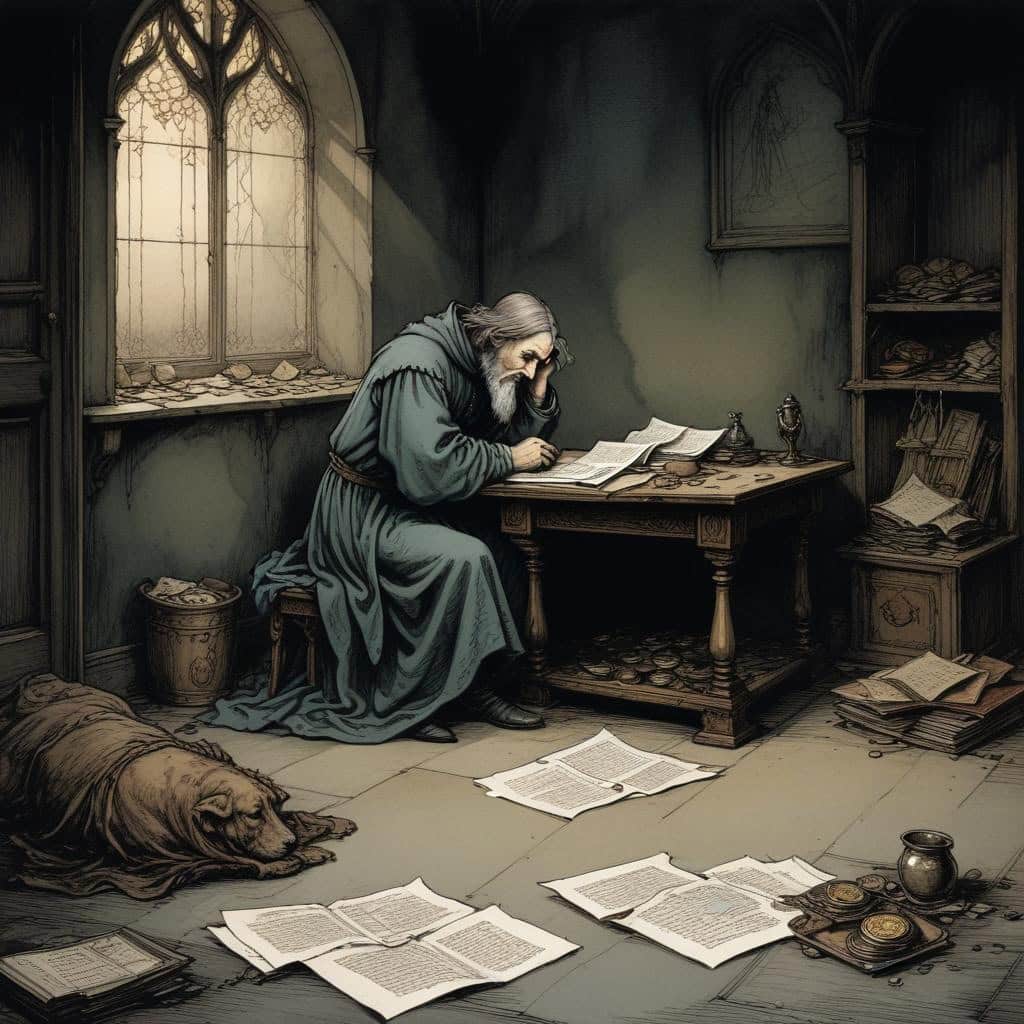
Chaucers Reflection on his Financial Situation

Chaucers Satirical Tone

Chaucers Hope for a Brighter Future

Lesson Details & Resources
In a Nutshell
- What: A poem by Geoffrey Chaucer
- When: Medieval period
- Who: Chaucer, his purse
- Theme: Financial struggles and the desire for wealth
List of Characters in The Complaint of Chaucer to his Purse
-
Chaucer
Chaucer, the poet who laments the lack of money in his purse
-
Purse
Purse, the object of Chaucer's complaint
-
Mars
Mars, the god of war who Chaucer wishes would bring him riches
-
Venus
Venus, the goddess of love who Chaucer hopes will bring him fortune
-
Mercury
Mercury, the god of commerce and trade who Chaucer appeals to for financial help
Timeline of The Complaint of Chaucer to his Purse
Chaucer complains about the lack of money in his purse.
He addresses his purse directly and asks it to tell him where his money went.
Chaucer reminisces about the time when his purse used to be full of gold coins.
He accuses his purse of betraying him and leaving him in poverty.
Chaucer expresses his desire to have money again and promises to take better care of it.
He wonders if his purse has been stolen or lost.
Chaucer pleads with his purse to return and fill itself with gold once more.
He suggests that his purse may have chosen to abandon him because he has become old and gray.
Chaucer expresses his frustration and anger towards his empty purse.
He acknowledges that he has been a spendthrift in the past but promises to change his ways.
Chaucer ends the poem by asking his purse to come back to him and be filled with money once again.
Vocabulary List
- Purse
- The central theme of the poem, Chaucer appeals to his purse for financial assistance.
- Lack
- Chaucer laments the lack of funds in his purse, leading to his financial struggles.
- Bounty
- Chaucer highlights the generosity and bounty of his purse in the past, contrasting it with his current situation.
- Dearth
- Chaucer describes the dearth of resources in his purse, emphasizing his financial distress.
- Thrift
- Chaucer criticizes his own lack of thrift in managing his finances, leading to his current predicament.
- Suffice
- Chaucer pleads for his purse to suffice his financial needs, acknowledging his dependency on it.
- Expend
- Chaucer reflects on the ways in which he has expended the contents of his purse, leading to his current state of poverty.
Key Facts
This is the information used in the fact matching game
- - The Complaint of Chaucer to his Purse is a poem written by Geoffrey Chaucer.
- - It is a satirical poem believed to have been written around 1399.
- - The poem is also known as "Purse," "A Complaint to his Purse," or "A Piteous Complaint."
- - Chaucer was a renowned English poet and author, best known for his work "The Canterbury Tales."
- - The poem serves as a direct appeal from Chaucer to his own purse, which represents his financial hardships.
- - Chaucer wrote the poem during a period of his life when he faced financial difficulties and struggled to maintain his lifestyle.
- - It is believed that Chaucer's complaints in the poem were influenced by his experiences as a public servant and his struggle to receive payments owed to him.
- - The poem expresses the poet's frustration and desperation for financial support.
- - Chaucer paints a vivid picture of his dire situation, emphasizing his inability to pay his debts and meet his basic needs.
- - He pleads with his purse to provide him with the means to survive and maintain his social standing.
- - Chaucer uses humor and irony throughout the poem to highlight the absurdity of his predicament.
- - The poem showcases Chaucer's skill in employing satire to criticize societal and economic issues of his time.
- - It is written in Middle English, the language commonly used in England during the medieval period.
- - The Complaint of Chaucer to his Purse is considered one of Chaucer's shorter works.
- - The poem consists of 77 lines divided into seven stanzas.
- - Chaucer's use of rhymed couplets and regular meter adds to the poem's lyrical quality.
- - Some scholars interpret the poem as a commentary on the corrupt nature of the financial system during Chaucer's time.
- - The Complaint of Chaucer to his Purse is often studied alongside Chaucer's other works to gain a deeper understanding of his literary style and social commentary.
- - The poem reflects Chaucer's personal struggles and offers insights into the financial challenges faced by writers and artists in the medieval period.
- - Despite his complaints, Chaucer's talent and reputation eventually garnered him royal favor, granting him financial stability later in life.
Analysis & Significance
Impact on Literature
‘The Complaint of Chaucer to his Purse’ is a satirical poem that showcases Chaucer’s wit and humor, setting a precedent for future writers to explore social and economic issues in their work. This work laid the foundation for the development of social commentary in literature, influencing generations of writers to use poetry as a tool for critiquing societal norms and values.
Enduring Themes
This poem delves into themes of wealth, power, and the struggle for financial stability, which are still relevant in today’s society. Chaucer’s critique of materialism and greed resonates with modern audiences, as it prompts readers to reflect on the value of money and the impact it has on individuals and society as a whole.
Cultural Significance Today
‘The Complaint of Chaucer to his Purse’ remains a classic work in English literature, studied for its historical context and linguistic richness. This poem has been adapted and referenced in various forms of media, showcasing its enduring legacy and influence on popular culture. Chaucer’s clever use of satire continues to inspire writers and artists to engage with social issues through their work, ensuring its relevance in contemporary discussions on wealth and inequality.
The Complaint of Chaucer to his Purse Games


Take Your Learning Offline
Want a convenient, print-ready study guide for this lesson? Become a Memory Wizards Pro member to unlock the downloadable " Memory Scrolls" for this topic and our entire library!
- ✓ Complete Vocabulary Lists
- ✓ Key Facts & Timelines
- ✓ Beautifully Formatted for Print & Mobile