
How Do You Learn Best?
Learn by Reading
Immerse yourself in the 10-minute visual lesson for a comprehensive understanding of the topic.
Learn by Reviewing
Jump directly to the key facts, timeline, and vocabulary lists to build a solid foundation of details.
Learn by Doing
Challenge yourself! Jump straight into the interactive games to learn by trial, error, and discovery.
A Treatise on the Astrolabe in 10 Minutes
Introduction


Geoffrey Chaucer

Lewis the Astronomer

Philippa Roet
1. Introduction to A Treatise on the Astrolabe
2. Purpose of the Astrolabe
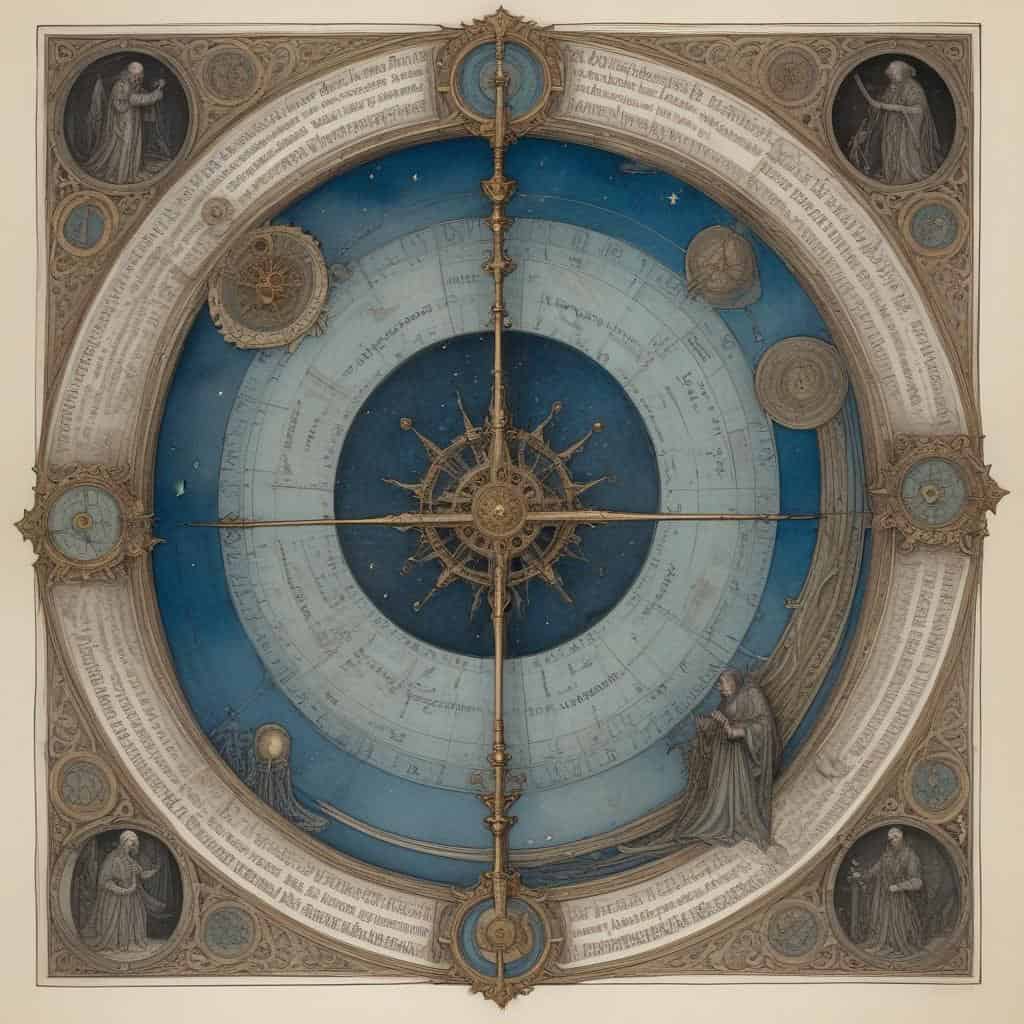
3. Parts of the Astrolabe
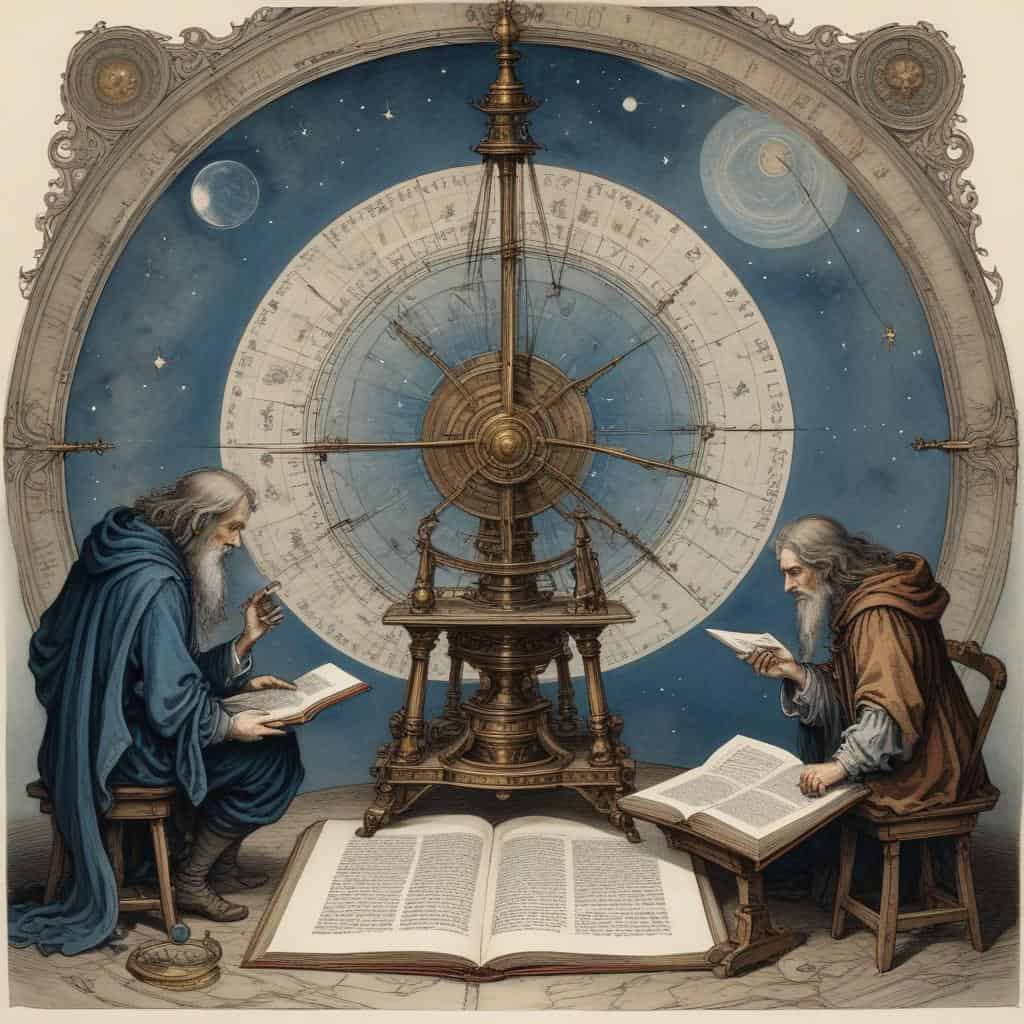
4. How to Use the Astrolabe
5. Applications of the Astrolabe
6. Importance of Astronomy
7. Historical Context
8. Influence of the Treatise
9. Legacy of Chaucer
10. Conclusion
Lesson Details & Resources
In a Nutshell
- What: A Treatise on the Astrolabe by Geoffrey Chaucer
- When: Written in the 14th century
- Who: Geoffrey Chaucer
- Theme: Instruction on how to use an astrolabe for astronomical measurements
List of Characters in A Treatise on the Astrolabe
-
Geoffrey Chaucer
Geoffrey Chaucer is the author of A Treatise on the Astrolabe.
-
Little Lewis
Little Lewis is Chaucer's son who the treatise is dedicated to.
-
Philip
Philip is mentioned in the treatise as a potential audience member.
Timeline of A Treatise on the Astrolabe
A Treatise on the Astrolabe:
The narrator begins by explaining that he will write a treatise on the astrolabe for his son.
He describes the astrolabe as a scientific instrument used for observing the stars and determining their positions.
The narrator mentions that the astrolabe is composed of various parts, including the rete and the plates.
He explains how to construct an astrolabe and how to divide its parts accurately.
The narrator provides detailed instructions on how to use the astrolabe for various purposes, such as finding the time, determining the height of celestial bodies, and calculating degrees.
He explains how to use the astrolabe to determine the latitude of a specific location.
The narrator emphasizes the importance of practicing and mastering the use of the astrolabe.
He discusses various errors that can occur when using the astrolabe and provides methods to correct them.
The narrator concludes the treatise by expressing his hope that his son will find the information valuable and encourages him to continue studying and improving his knowledge of the astrolabe.
Vocabulary List
- Astrolabe
- The astrolabe is a medieval instrument used to observe the positions of celestial bodies.
- Latitude
- Latitude is a measurement that specifies the north-south position of a point on the Earth's surface.
- Zodiac
- The zodiac is a band of the celestial sphere within which most of the planets orbit.
- Equator
- The equator is an imaginary line that divides the Earth into the Northern and Southern Hemispheres.
- Ecliptic
- The ecliptic is the apparent path of the sun across the sky.
- Declination
- Declination is the angle between a celestial object and the celestial equator.
- Meridian
- The meridian is an imaginary line that runs from the North Pole to the South Pole.
- Zenith
- The zenith is the point in the sky directly above an observer.
Key Facts
This is the information used in the fact matching game
- Geoffrey Chaucer wrote A Treatise on the Astrolabe around 1391.
- The treatise is a manual on how to use an astrolabe, a medieval instrument used for navigation and astronomy.
- Chaucer wrote the treatise for his son, Lewis.
- The treatise is written in Middle English.
- Chaucer includes instructions on how to calculate the altitude of the sun and stars using the astrolabe.
- The treatise is one of the earliest technical manuals written in English.
- Chaucer's treatise was based on an earlier work by the Arab astronomer Al-Farghani.
- The astrolabe was commonly used by sailors and astronomers in the medieval period.
- The treatise includes detailed instructions on how to construct an astrolabe.
- Chaucer's treatise helped popularize the use of the astrolabe in medieval Europe.
- The treatise is divided into five parts, each covering a different aspect of the astrolabe.
- Chaucer was a well-known poet and author in his time, best known for The Canterbury Tales.
- The astrolabe was used for determining the time of day, as well as for navigation and astronomy.
- Chaucer's treatise is considered one of the most important works on the astrolabe from the medieval period.
- The astrolabe was introduced to Europe from the Islamic world in the 11th century.
- Chaucer's treatise includes discussions on the motion of the sun, moon, and stars.
- The astrolabe was used for determining the positions of celestial bodies in the sky.
- Chaucer's treatise was likely intended to educate his son in the art of astronomy and navigation.
- The astrolabe was a complex instrument with multiple parts, used for measuring angles and distances in the sky.
- Chaucer's treatise is written in a practical and accessible style, making it easier for readers to understand the complex instrument.
Analysis & Significance
Impact on Literature
‘A Treatise on the Astrolabe’ is a foundational work in the history of literature, as it represents one of the earliest examples of technical writing in the English language. This work set a precedent for future writers to explore complex subjects in a clear and accessible manner, influencing the development of scientific and instructional texts in the centuries to come.
Enduring Themes
Despite its technical nature, ‘A Treatise on the Astrolabe’ touches on themes that are still relevant today, such as the pursuit of knowledge, the importance of education, and the relationship between science and society. These timeless themes continue to resonate with modern audiences, reminding us of the value of learning and understanding the world around us.
Cultural Significance Today
The legacy of ‘A Treatise on the Astrolabe’ can be seen in its influence on literature, science, and education. This work has been studied, translated, and adapted over the centuries, with scholars and writers alike recognizing its importance in the history of English literature. Its famous adaptations have helped to keep its legacy alive, ensuring that future generations continue to appreciate its contributions to the literary world.
A Treatise on the Astrolabe Games


Take Your Learning Offline
Want a convenient, print-ready study guide for this lesson? Become a Memory Wizards Pro member to unlock the downloadable " Memory Scrolls" for this topic and our entire library!
- ✓ Complete Vocabulary Lists
- ✓ Key Facts & Timelines
- ✓ Beautifully Formatted for Print & Mobile