
How Do You Learn Best?
Learn by Reading
Immerse yourself in the 10-minute visual lesson for a comprehensive understanding of the topic.
Learn by Reviewing
Jump directly to the key facts, timeline, and vocabulary lists to build a solid foundation of details.
Learn by Doing
Challenge yourself! Jump straight into the interactive games to learn by trial, error, and discovery.
Exiles by James Joyce in 10 Minutes
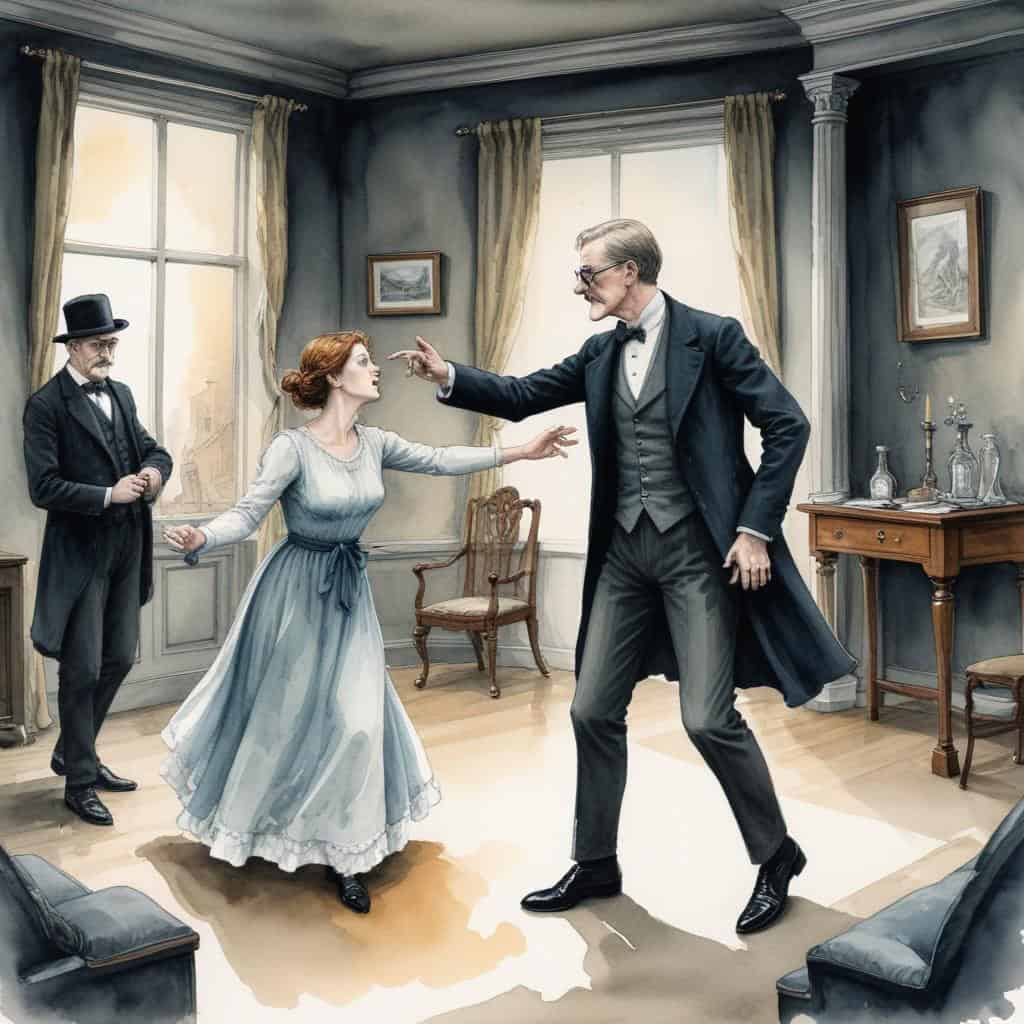
Introduction



Richard Rowan

Bertha Rowan

Beatrice Justice

The Departure

The Reunion

The Confession

The Betrayal

The Confrontation

The Reflection

The Resolution

The Return

The Redemption

The Legacy

Lesson Details & Resources
In a Nutshell
- What: Exiles by James Joyce
- When: Written in the early 20th century
- Who: Richard Rowan, Bertha, and Robert Hand
- Theme: The exploration of love, betrayal, and self-discovery
List of Characters in Exiles by James Joyce
-
Leopold Bloom
Leopold Bloom is the protagonist of the story, a Jewish man living in Dublin.
-
Molly Bloom
Molly Bloom is Leopold Bloom's wife, who has an affair with Blazes Boylan.
-
Stephen Dedalus
Stephen Dedalus is a young artist and intellectual who is a central character in the story.
-
Mr. Deasy
Mr. Deasy is Stephen Dedalus' employer and a school headmaster.
-
Blazes Boylan
Blazes Boylan is Molly Bloom's lover and a key figure in the story.
-
Simon Dedalus
Simon Dedalus is Stephen Dedalus' father and a prominent figure in Dublin society.
Timeline of Exiles by James Joyce
Stephen Dedalus leaves Ireland and travels to Paris to pursue his artistic ambitions.
Stephen struggles with feelings of alienation and disillusionment as he navigates the Parisian art scene.
Stephen returns to Ireland and begins teaching at a boys' school.
Stephen's relationship with his students becomes strained as he grapples with his own inner turmoil.
Stephen's mother falls ill and he is forced to confront his feelings of guilt and resentment towards her.
Stephen begins to question his own identity and purpose in life.
Stephen decides to leave Ireland once again and travels to Trieste.
Stephen meets a woman named Emma and the two begin a tumultuous relationship.
Stephen's relationship with Emma becomes increasingly toxic and he realizes he must break free from her.
Stephen decides to leave Trieste and return to Paris to start anew.
Vocabulary List
- Exile
- The main theme of the novel is the experience of being an exile from one's homeland.
- Nostalgia
- The protagonist often feels nostalgia for his home country.
- Alienation
- The sense of alienation from society is a recurring motif in the novel.
- Estrangement
- The protagonist's estrangement from his family and friends is a central conflict.
- Isolation
- The character's isolation in a foreign land is a source of great sadness.
- Displacement
- The feeling of displacement is a common experience for many of the characters.
- Loneliness
- The protagonist struggles with feelings of loneliness and isolation throughout the novel.
- Belonging
- The search for a sense of belonging is a driving force for the protagonist.
- Identity
- The protagonist grapples with questions of identity and selfhood as an exile.
- Estranged
- The protagonist feels estranged from his own culture and heritage.
Key Facts
This is the information used in the fact matching game
- Exiles is a play written by James Joyce in 1914.
- The play is based on the story of a man named Richard Rowan who returns to Ireland after living in Rome for many years.
- Exiles was Joyce's only play and was first performed in Munich in 1919.
- The play explores themes of love, betrayal, and the search for identity.
- Exiles was not well received by critics and audiences when it was first performed.
- The characters in Exiles are loosely based on Joyce and his own personal relationships.
- The play is written in three acts and is set in Dublin.
- Exiles has been adapted into a radio play and has been performed in various theaters around the world.
- The play explores the complexities of human relationships and the nature of artistic creation.
- Exiles is considered one of Joyce's lesser known works but is still studied and analyzed by scholars.
- The play raises questions about the role of the artist in society and the sacrifices that are made for art.
- Exiles is written in Joyce's signature modernist style, with complex narrative structures and interior monologues.
- The play has been compared to Joyce's other works such as Ulysses and Dubliners.
- Exiles explores the tension between personal desires and societal expectations.
- The play delves into themes of exile, both literal and metaphorical, and the impact it has on individuals.
- Exiles is considered a challenging work that requires close reading and analysis to fully appreciate.
- The play has been translated into multiple languages and continues to be performed in theaters worldwide.
- Exiles has been praised for its exploration of complex emotions and relationships in a modernist context.
- The play's themes of love, betrayal, and self-discovery resonate with audiences across cultures and time periods.
- Exiles is a powerful and evocative work that showcases Joyce's talent as a playwright and literary innovator.
Analysis & Significance
Impact on Literature
‘Exiles’ by James Joyce is a seminal work in modernist literature, known for its experimental narrative style and exploration of themes such as identity, exile, and the search for meaning in a fragmented world. Joyce’s innovative use of stream-of-consciousness technique and intricate character development has influenced generations of writers, paving the way for new forms of storytelling in the 20th century and beyond.
Enduring Themes
The themes of alienation, betrayal, and the struggle for personal and artistic freedom in ‘Exiles’ continue to resonate with modern audiences. Joyce’s portrayal of characters grappling with their own inner conflicts and societal expectations speaks to universal experiences of love, loss, and the complexities of human relationships, making the work timeless and relevant in today’s world.
Cultural Significance Today
‘Exiles’ remains a celebrated literary work that has been adapted into various forms, including stage productions and film adaptations. Its exploration of Irish identity and the complexities of relationships has made it a staple in discussions of modernist literature and the Irish literary canon. Joyce’s impact on literature and his ability to capture the human condition in all its complexities ensure that ‘Exiles’ continues to be studied and appreciated by readers and scholars worldwide.
Exiles by James Joyce Games


Take Your Learning Offline
Want a convenient, print-ready study guide for this lesson? Become a Memory Wizards Pro member to unlock the downloadable " Memory Scrolls" for this topic and our entire library!
- ✓ Complete Vocabulary Lists
- ✓ Key Facts & Timelines
- ✓ Beautifully Formatted for Print & Mobile