
Summary of Domesday Book
Unlock the secrets of England's ancient census in the Domesday Book.
How Do You Learn Best?
Learn by Listening
Start with the 3-minute audio summary to get the key facts and narrative highlights quickly.
Learn by Reading
Immerse yourself in the 10-minute visual lesson for a comprehensive understanding of the topic.
Learn by Reviewing
Jump directly to the key facts, timeline, and vocabulary lists to build a solid foundation of details.
Learn by Doing
Challenge yourself! Jump straight into the interactive games to learn by trial, error, and discovery.
Audio Library
As one of our featured lessons, this topic includes premium audio guides.
Unlock the Wizard's Cram Session
This powerful audio study guide is a Pro-exclusive feature. Upgrade to Memory Wizards Pro to access this and all of our premium learning tools.
Upgrade to ProDomesday Book in 10 Minutes

Introduction


William the Conqueror
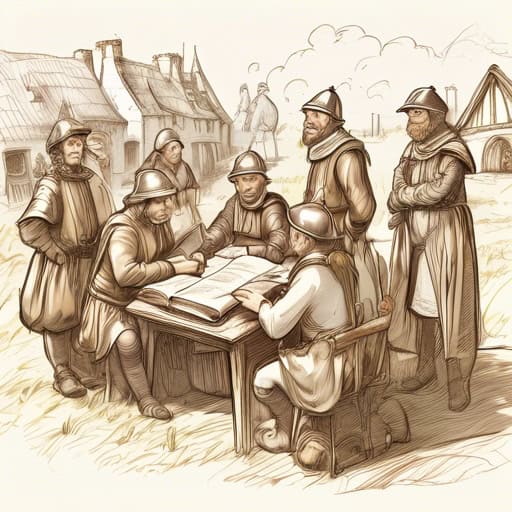
King Williams Commissioners

Taxpayers and Landowners

Anglo-Saxon Nobility

The Compilation of Domesday Book

The Purpose of Domesday Book

The Contents of Domesday Book

The Importance of Domesday Book

The Significance of Domesday Book

The Legacy of Domesday Book

The Preservation of Domesday Book

The Accessibility of Domesday Book

The Continued Interest in Domesday Book

The Enduring Legacy of Domesday Book

Lesson Details & Resources
In a Nutshell
- What: A comprehensive survey of England conducted by William the Conqueror.
- When: 1086
- Who: William the Conqueror, landowners, tenants-in-chief.
- Outcome: Provided detailed records of land ownership and taxable value in England, aiding in the centralization of power.
Famous Figures in the Domesday Book
-
William the Conqueror
The ruler who commissioned the Domesday Book and led the Norman Conquest of England.
-
Lanfranc
The first Norman Archbishop of Canterbury who played a key role in the compilation of the Domesday Book.
-
Odo of Bayeux
A half-brother of William the Conqueror and one of the major landholders listed in the Domesday Book.
-
Roger of Salisbury
A prominent Norman bishop who was responsible for the organization and implementation of the Domesday survey.
-
William of Poitiers
A medieval chronicler who documented the events leading up to the Norman Conquest and the compilation of the Domesday Book.
-
Robert, Count of Mortain
A half-brother of William the Conqueror and a significant landholder and political figure during the compilation of the Domesday Book.
-
Henry I
The son of William the Conqueror who succeeded him as King of England and took an interest in the Domesday Book.
-
Richard de Clare
A prominent Anglo-Norman nobleman who held extensive lands and was listed as a tenant-in-chief in the Domesday Book.
-
Walter Giffard
A powerful Norman bishop who played a role in the compilation of the Domesday Book and held extensive lands in England.
-
Hugh de Grandmesnil
A Norman nobleman who held significant lands and was recorded as a tenant-in-chief in the Domesday Book.
Timeline of Domesday Book
William the Conqueror commissions the Domesday Book
Surveying of properties and land begins
Completion of the Great Domesday and Little Domesday
Domesday Book presented to William the Conqueror
Publication and distribution of the Domesday Book
Start of Domesday Book's influence on taxation
Domesday Book used as evidence in land disputes
King John orders Domesday Book to be moved to Westminster
First official public exhibition of the Domesday Book
Domesday Book used as a source for local history studies
Domesday Book translated into English by Abraham Farley
Domesday Book used for genealogical research
Domesday Book used as reference for historical population data
First complete photographic facsimile of the Domesday Book
Domesday Book made available online
900th anniversary of the Domesday Book celebrated
New research reveals insights into Domesday Book's creation
Domesday Book added to UNESCO Memory of the World Register
Domesday Book undergoes major conservation work
Domesday Book continues to be a valuable historical resource
Vocabulary List
- Domesday Book
- The Domesday Book is a historical record of England, created in 1086 during the reign of William the Conqueror.
- Census
- The Domesday Book can be considered as an early form of census, providing information about land ownership, population, and resources.
- Survey
- The Domesday Book was the result of a comprehensive survey conducted across England, documenting details about land and property.
- Feudal System
- The Domesday Book reflects the feudal system of medieval England, with information about feudal lords, tenants, and their obligations.
- Taxation
- The Domesday Book was also used as a means of taxation, as it provided valuable data for assessing and collecting taxes.
- Manors
- The Domesday Book contains extensive information about manors, including their size, resources, and the people who lived and worked on them.
- Inquisition
- The creation of the Domesday Book involved an inquisition, where commissioners traveled across England to gather information from local communities.
Key Facts
This is the information used in the fact matching game
- The Domesday Book was commissioned by William the Conqueror in 1085.
- It was completed in 1086.
- The book was a survey of England's land and resources.
- Its purpose was to determine the value of land and how it was used.
- The survey covered 13,418 settlements across England.
- It recorded details about landowners, tenants, and resources.
- The book's name, Domesday, means 'Doomsday' or 'Day of Judgment' in Old English.
- The book was written in Latin.
- There are two versions of the Domesday Book: Great Domesday and Little Domesday.
- Great Domesday covers most of England, while Little Domesday focuses on Essex, Norfolk, and Suffolk.
- The book provides valuable information about the social and economic structure of medieval England.
- It reveals the impact of the Norman Conquest on England's landownership.
- The Domesday Book is still used by historians and researchers today.
- It helps in understanding medieval landholding patterns and the feudal system.
- The book also sheds light on the agricultural practices and resources of the time.
- The survey included information on mills, fisheries, woodlands, meadows, and more.
- The Domesday Book is held at the National Archives in Kew, London.
- It is one of the most famous and earliest surviving public records.
- The book consists of two volumes, written on parchment.
- The original binding of the Domesday Book no longer survives.
- The book's appearance is similar to a modern-day ledger or account book.
- The handwriting in the Domesday Book is known as 'Anglo-Saxon square minuscule.'
- The book was compiled by a team of scribes and clerks.
- It was a monumental undertaking and took several years to complete.
- The survey was highly detailed and aimed to be comprehensive.
- The Domesday Book was used to assess taxes and land values.
- It was also used to settle disputes and legal claims over land.
- The book is a vital source for studying English genealogy and family history.
- Domesday Book entries are organized by county, then by settlement.
- The information in the book was gathered through in-person surveys and witness testimonies.
- The Domesday Book is a testament to the administrative and bureaucratic capabilities of medieval England.
Analysis & Significance
Immediate Consequences
The immediate consequences of the Domesday Book were significant as it allowed William the Conqueror to efficiently administer his newly acquired kingdom. It provided detailed information on land ownership, wealth, and resources, enabling him to impose taxes and assert his control over England.
Long-Term Impact
The long-term impact of the Domesday Book cannot be overstated. It became a crucial tool for governance, taxation, and legal disputes in medieval England. Its comprehensive data collection and meticulous recording set a precedent for future record-keeping practices, influencing administrative systems for centuries to come.
Cultural Significance Today
Today, the Domesday Book remains a vital historical document, offering valuable insights into medieval society and landholding patterns. It serves as a testament to the power and efficiency of centralized record-keeping, shaping our understanding of governance and administration in the Middle Ages. Its legacy continues to inspire scholars and historians, highlighting the enduring importance of accurate documentation and data preservation.
Domesday Book Games


Take Your Learning Offline
Want a convenient, print-ready study guide for this lesson? Become a Memory Wizards Pro member to unlock the downloadable " Memory Scrolls" for this topic and our entire library!
- ✓ Complete Vocabulary Lists
- ✓ Key Facts & Timelines
- ✓ Beautifully Formatted for Print & Mobile